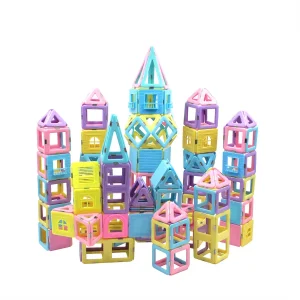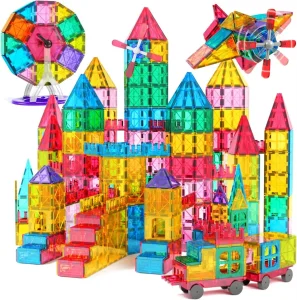
Inspected and certified for European educational networks, crèches, and retail distributors.
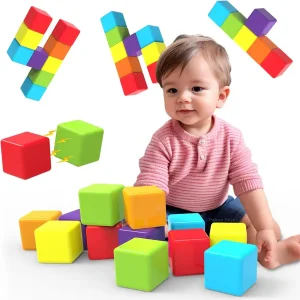
The European educational toy sector, valued at over €3.4 billion annually, has experienced a decisive structural shift toward STEM (Science, Technology, Engineering, and Mathematics) and STEAM-aligned construction toys. Within this sector, France represents one of the largest and most quality-conscious markets in Western Europe. Search trends and procurement requisitions for terms like "Magnetic Building Cube Factory in France" and "Fabrique de cubes magnétiques en France" highlight an accelerating demand among French toy brand owners, educational supply distributors (supplying Écoles Maternelles and Centres de Loisirs), and major retail networks (such as Fnac, JouéClub, La Grande Récré, and Cultura).
However, the macroeconomic reality of modern toy manufacturing presents a profound operational dilemma for European enterprises. Producing precision magnetic building cubes requires automated high-frequency ultrasonic welding, precision injection molding of non-toxic ABS, and secure encapsulation of high-grade N35/N38 Neodymium rare-earth magnets. While traditional French toy manufacturing hubs—such as the historic Jura region—excel in artisanal wooden craftsmanship, local industrial infrastructure for mass-scale, high-velocity plastic ultrasonic magnetic toy production remains sparse and extraordinarily capital-intensive.
To remain competitive against tight European retail price points while guaranteeing 100% compliance with strict EU Toy Safety Directive 2009/48/EC and EN71 standards, French brand owners increasingly utilize a hybrid procurement model: local French distribution and branding coupled with specialized OEM/ODM manufacturing partnerships located in premier Chinese industrial clusters such as Yongkang, Zhejiang.
This whitepaper provides procurement directors, supply chain managers, and educational toy brand strategists with an authoritative analysis of the global magnetic building cube manufacturing landscape, comparing domestic French production dynamics against high-capacity China factories, while outlining strict technical standards, compliance requirements, and OEM integration methodologies.
Empirical metrics driving global B2B partnerships with French and European distributors.
When searching for a magnetic building cube factory in France, European buyers frequently evaluate whether to source domestically or contract directly with China-based manufacturing leaders like Yongkang YuQi Industry and Trade Co., Ltd. Below is a structural comparative breakdown across essential industrial parameters:
| Evaluation Parameter | Domestic French Factories | Advanced China OEM Factory (e.g., YuQi) |
|---|---|---|
| Primary Industrial Focus | Artisanal wood, small-batch luxury plastics, boutique design tooling. | High-volume precision injection, automated ultrasonic welding, global mass distribution. |
| Unit Production Cost | High (Driven by electricity rates, labor costs, and localized raw material overhead). | Optimized (Benefit of complete Zhejiang industrial cluster & supply chain integration). |
| Tooling & Mold Development | 8 to 14 weeks lead time; high initial capital expenditure (€15k - €30k per cavity mold). | 3 to 5 weeks lead time; rapid prototyping, internal CNC mold workshop, flexible cost amortization. |
| Ultrasonic Welding Automation | Limited scale; often requires multi-tier outsourcing for ultrasonic plastic encapsulation. | Fully automated robotic ultrasonic welding lines ensuring uniform shell strength (>80N tensile pull test). |
| Magnet Sourcing & Assembly | Relies on imported neodymium magnets, increasing assembly cost per cube unit. | Direct integration with local rare-earth processing facilities; customized flux density (Gauss level). |
| European Regulatory Certification | Third-party local testing required (SGS France, Bureau Veritas Paris). | Pre-certified factory lines with ready EN71-1/2/3, CE, ASTM, CPSIA, REACH, and ISO9001 documentation. |
While domestic French facilities provide unbeatable proximity and quick turnaround for short-run promotional items, Chinese manufacturing powerhouses deliver the industrial scale, rigorous engineering tolerances, and economic efficiency needed to supply large-scale retail chains across France and Europe.
The safety of magnetic building toys is tightly regulated due to historical safety hazards associated with loose, ingestible high-powered magnets. Under European Safety Standard EN 71-1:2014+A1:2018 (Safety of Toys - Mechanical and Physical Properties), any magnetic component small enough to fit inside a truncation cylinder must possess a magnetic flux index of less than 50 kG²mm², or be permanently enclosed in a structural plastic shell capable of withstanding severe impact and drop testing.
Our magnetic cubes feature a proprietary internal lattice with reinforced locking columns. Even under high impact or mechanical stress, the cylindrical magnet remains locked in its chamber, completely preventing detachment.
Plastic shells are fused using 28kHz high-frequency ultrasonic energy. This creates a molecular bond along the perimeter seam that exceeds EU drop-test requirements (EN 71-1 Section 8.5) and 90N pull force thresholds.
To ensure effortless 3D construction for young children, cylindrical N35 Neodymium magnets are housed inside spherical or smooth cylindrical slots, allowing them to self-align instantly regardless of polarity.
Furthermore, raw materials must satisfy the strict chemical parameters set forth by the REACH Directive (EC 1907/2006) Annex XVII, verifying the total absence of Phthalates (DBP, BBP, DEHP, DINP), Polycyclic Aromatic Hydrocarbons (PAHs), and heavy metal migration (lead, cadmium, mercury) per EN 71-3 testing.
Understanding how magnetic building cubes are utilized within France enables distributors to position their private-label product lines effectively:
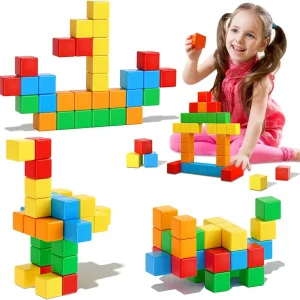
In French Écoles Maternelles (Petite, Moyenne, and Grande Sections), early childhood education stresses spatial awareness, geometry, fine motor control, and cooperative play. Magnetic building cubes serve as indispensable manipulatives for teachers, offering intuitive visual aids for introducing 3D shapes, symmetry, and volume calculation without the frustration of rigid snap-together blocks.
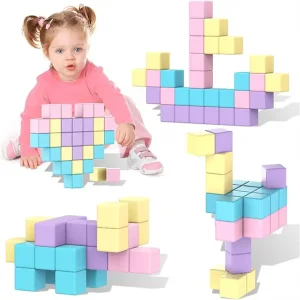
France has seen a massive surge in private Montessori and Reggio Emilia-inspired learning academies across major metropolitan areas like Île-de-France, Lyon, Toulouse, and Bordeaux. Magnetic cubes engineered in muted, harmonious pastels (such as our Macaron Series) align perfectly with modern sensory learning environments that emphasize tactile exploration and self-directed activity.
French retail buyers demand shelf-ready aesthetic packaging that complies with French linguistic regulations. Under the Toubon Law (Loi Toubon) and the recent AGEC Law (Loi Anti-Gaspillage pour une Économie Circulaire), products distributed in France must feature clear French-language instructional copy, safety warnings, and the mandatory Triman Logo for packaging recyclability sorting. Partnering with an experienced OEM factory ensures seamless compliance with all packaging regulations directly from the production facility.
For procurement executives managing international supply chains, sourcing from a China factory for distribution into France (via ports like Le Havre, Marseille-Fos, or Dunkirk) requires precise logistics integration:
As sustainability regulations intensify across Europe (especially in France under the AGEC framework), toy manufacturers are innovating rapidly. Key developmental trajectories include:
1. Recycled & Bio-Based ABS Plastics (rABS): Replacing virgin fossil-fuel ABS resins with post-consumer recycled ABS or bio-attributed resins without sacrificing impact resistance or clarity.
2. Tactile & Textured Sensory Cubes: Integrating geometric textures, embossed letters, braille, and numbers into the exterior faces of the cube, transforming simple magnetic construction into multi-sensory literacy and math tools.
3. AR & Digital STEM Integration: Combining physical magnetic cube builds with Augmented Reality (AR) mobile applications, allowing French students to scan their 3D structures and interact with virtual physics simulations.
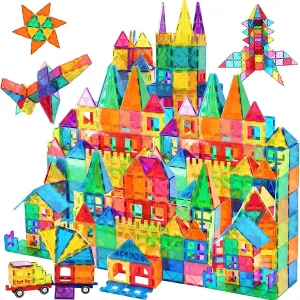
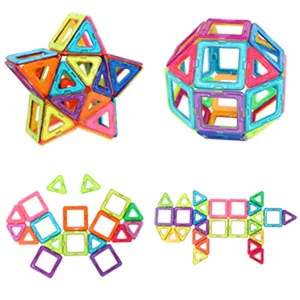
Explore our complete range of certified magnetic building blocks, tiles, and 3D cubes available for private-label production.
Answers to fundamental operational, regulatory, and supply chain questions from European buyers.
While local French suppliers provide quick proximity, specialized China OEM factories possess integrated industrial ecosystems (high-precision automated plastic injection, localized rare-earth magnet sourcing, and automated 28kHz ultrasonic welding lines). This infrastructure yields unit cost efficiencies of 40% to 65% while easily satisfying strict European EN71 safety standards.
Every product line undergoes third-party lab testing (SGS, TUV, or Intertek) covering EN 71-1 (Mechanical/Physical Properties), EN 71-2 (Flammability), and EN 71-3 (Migration of Heavy Elements). Furthermore, raw ABS resin is verified free of Phthalates and PAHs under REACH Annex XVII.
Standard OEM private-label MOQs typically start at 500 to 1,000 sets per SKU depending on custom color matching (Pantone) and specialized packaging specifications. Sample testing orders are available for initial quality evaluation.
Yes. Our factory provides complete OEM graphic adaptation, including logo laser-engraving or mold embossing on individual cubes, along with full-color retail box printing featuring the mandatory French Triman recycling logo, AGEC compliance markings, and Toubon Law French warning texts.
We utilize high-flux N35 to N38 Neodymium (NdFeB) permanent rare-earth magnets. These are encapsulated in rotating internal cylindrical housings, ensuring the cubes snap together easily regardless of magnetic polarity while providing structural hold for complex 3D builds.
We employ high-energy 28kHz ultrasonic welding machines equipped with continuous digital frequency tracking. This melts and fuses the ABS plastic housing along its internal tongue-and-groove perimeter, resulting in a seamless bond that withstands over 90 Newtons of tensile force and drop testing onto solid concrete.
Mass production standard lead time is 20 to 28 days following artwork approval and deposit confirmation. Ocean transit from Ningbo/Shanghai port to main Western European ports adds approximately 28 to 35 transit days.
Yes. Fully documented ISO9001 quality system certificates, BSCI social compliance audit reports, and third-party product testing reports are available upon request to assist with vendor onboarding.
Looking to develop or scale your magnetic building cube product line for France and the European market? Contact our B2B engineering team today for factory-direct pricing, sample requests, and OEM custom solutions.
Send Inquiry Now