
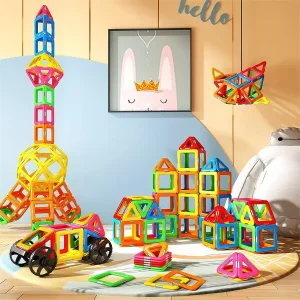
Examining the structural growth drivers, technological shifts, and consumer behavior transformation within the global B2B STEM educational toy sector.
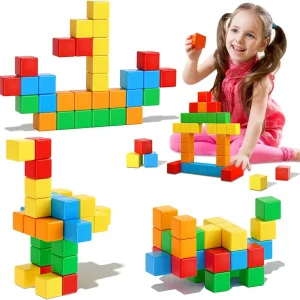
The global educational toy market is shifting rapidly from passive entertainment to STEAM-certified active inquiry play. Modern educational curriculums in North America and Western Europe are mandating hands-on spatial reasoning tools, driving B2B demand for modular magnetic building tiles and 3D architectural cubes.
Global brand owners, institutional importers, and Amazon FBA sellers are demanding direct partnership with highly automated factories. Sourcing hubs in Zhejiang, China are leading this transformation through advanced automated ultrasonic encapsulation and automated magnet insertion technologies.
With stringently enforced international safety protocols (ASTM F963-17, EN71, CPSIA), buyers can no longer risk structural magnet detachment. Leading wholesale suppliers must guarantee zero-glue mechanical interlock systems and lead-free non-toxic ABS materials.
Deconstructing what professional B2B buyers, educational toy brand managers, and retail chain buyers prioritize when auditing wholesale building toy suppliers.
When professional procurement directors evaluate wholesale STEM building toys manufacturers and suppliers, their intent extends far beyond simple unit-price comparisons. In today's volatile global supply chain environment, risk mitigation, compliance predictability, and modular manufacturing scalable capacities dominate the decision matrix.
Enterprise buyers require verifiable batch traceability. Toys must utilize virgin, non-recycled ABS (Acrylonitrile Butadiene Styrene) polymers that pass rigorous heavy-metal extraction, phthalate concentration, and BPA audits under EN71-3 and CPSIA guidelines.
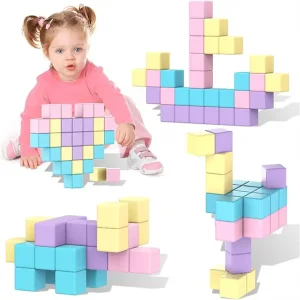
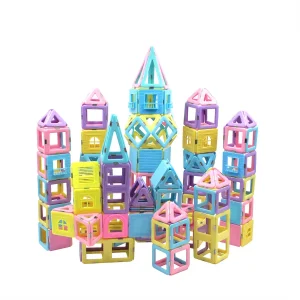
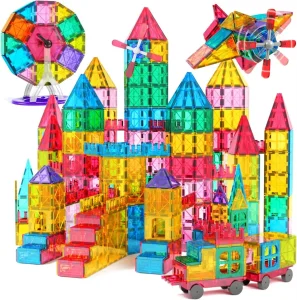
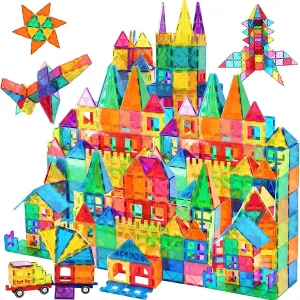
Top-tier brands demand customized color pantones (such as Macaron pastel palettes or high-clarity transparent crystal tiles), custom laser-etched branding, and bespoke box designs with minimal tooling lead times (15 to 25 days).
Ingestion of loose magnets represents the single greatest liability in the educational toy industry. Procurement teams mandate double-sealed ultrasonic welding coupled with inner structural lattice reinforcement to withstand impact force tests over 50 kg.
Importers need suppliers capable of scaling from sample verification batches to multi-container shipments (50,000+ sets per month) without quality degradation, backed by ISO9001 quality system enforcement.
By addressing these core procurement vectors through transparent engineering practices, certified factories provide brand partners with significant market expansion velocity and complete peace of mind.
An technical review of material selection, ultrasonic welding physics, and magnetic flux engineering in modern STEM building set manufacturing.
Traditional toy construction often relied on chemical adhesives or mechanical snap-fits. In magnetic tile manufacturing, adhesives degrade under ambient humidity or UV exposure, posing severe swallow hazard risks. Leading Chinese manufacturing facilities have engineered 35kHz High-Frequency Ultrasonic Fusion Welding.
This process applies controlled acoustic vibrations under pneumatic pressure to melt plastic interfaces instantly, fusing separate ABS tile shells into a single monolithic structural entity. Internal cross-bracing ribs are incorporated into the mold design to absorb mechanical energy during drop testing, satisfying strict EN71 drop-impact standards.
The playing satisfaction of magnetic building toys depends entirely on magnet pull-force ratios. Substandard toys use low-grade ferrite magnets that lack structural hold, resulting in collapsing 3D structures and consumer dissatisfaction.
| Engineering Attribute | Standard Commercial Grade | YuQi Industrial Benchmark Standard | B2B Operational Impact |
|---|---|---|---|
| Magnet Material | Low-cost Ferrite / Recycled NdFeB | Virgin N35 / N38 Sintered NdFeB | +40% stronger structural stability in 3D tall towers |
| Plating Protection | Single Ni Layer (Prone to Rust) | Triple Plating (Ni-Cu-Ni / Anti-Oxidant Epoxy) | Prevents internal corrosion from moisture or humidity |
| Outer Shell Polymer | Recycled Secondary ABS Plastisols | 100% Virgin Food-Grade ABS (LG Brand Chem) | Superior crystal optical clarity and high shatter-proof toughness |
| Sonic Weld Seam Strength | Direct Mechanical Glue / Low-Frequency Weld | 35kHz High-Precision Ultrasonic Seamless Fusion | Zero loose magnet risk; exceeds 100N pull-apart testing |
| Corner Radius Safety | Sharp Mold Edges (<1.5mm) | Ergonomic Smooth Radius (>3.0mm Rounded Edge) | Protects toddlers' delicate hands during high-impact sensory play |
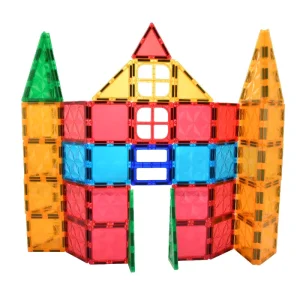
A frequent consumer friction point in transparent magnetic building tiles is surface scuffing during transit and play. Industrial solutions include micro-convex border bevels that elevate tile centers slightly away from flat surfaces. This architectural geometry reduces surface-to-surface friction, maintaining prism-like light refraction and color vibrant clarity through years of classroom usage.
Navigating complex international toy safety laws with ready-to-verify testing documentation and localized packaging support.
Full compliance with ASTM F963-17 (Physical & Mechanical Tests, Flammability, Heavy Elements), CPSIA Section 101 (Total Lead in Substrates), and Phthalates Regulation 16 CFR Part 1307. Children’s Product Certificates (CPC) provided for every production batch.
Certified under EN71 Part 1 (Mechanical), Part 2 (Flammability), and Part 3 (Migration of 19 Elements). Complies strictly with EU Toy Safety Directive 2009/48/EC, REACH SVHC chemical regulations, and carries valid CE marking with EU Authorized Representative support.
Comprehensive packaging localization including multi-language user instruction manuals (English, German, French, Spanish, Japanese), barcode compliance (UPC/EAN/FNSKU), warning label translations, and custom retail-ready display boxes.
Pioneering the next evolution of intelligent, sustainable, and multi-sensory magnetic building sets.
Pioneering the transition from traditional petroleum ABS to PLA-infused bio-composite polymers. Derived from renewable sugarcane and cornstarches, these eco-tiles maintain optical clarity while reducing carbon footprint by up to 38%.
Integrating safe low-voltage conductive magnetic polarities directly into tile edges. Children can build 3D structures that power LED light modules, sound blocks, and micro-fans without exposed wires or complex pins.
Developing companion Augmented Reality (AR) mobile software that scans physical magnetic tile builds. Children can bring their constructed castles, bridges, and magnetic vehicles to life in interactive 3D digital environments.
Essential answers for brand owners, distributors, and buyers negotiating wholesale building toy orders.
Our standard Minimum Order Quantity (MOQ) for standard factory color sets in bulk packaging is 500 sets. For custom private-label branding, customized pantone colors, or bespoke retail box designs, the typical MOQ ranges between 1,000 to 2,000 sets depending on package complexity. Flexible trial-order arrangements can be negotiated for first-time brand buyers.
Safety is paramount. All our magnetic tiles undergo a dual-security process: first, magnets are recessed into reinforced internal plastic channels; second, the outer shell halves are subjected to 35kHz high-power ultrasonic welding. We perform batch drop-tests from 1.5 meters onto hard concrete and conduct tensile pull-apart testing exceeding 100 Newtons to guarantee structural encapsulation.
We provide full documentation for every export market. Shipments to North America are accompanied by ASTM F963-17, CPSIA lead/phthalate reports, and CPC certificates. European orders include EN71 Parts 1, 2 & 3, REACH chemical compliance, and CE test reports issued by accredited third-party laboratories (SGS / TUV / Intertek).
Our standard production lead time is 20 to 25 days following artwork approval and deposit receipt for full container loads (FCL). For repeat OEM orders with existing molds, production lead time can be compressed to 15 business days. Air express sampling takes 5 to 7 business days.
Yes. Our in-house R&D team features advanced 3D CAD modeling, rapid SLA prototyping, and high-precision CNC mold tooling facilities. We can transform a conceptual sketch into a working physical sample within 10 days, with complete mass-production steel mold creation completed within 25 to 30 days.