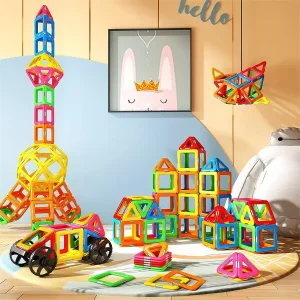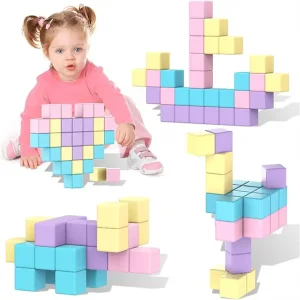
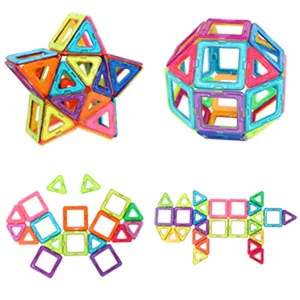
Direct-from-factory catalog items equipped with double-riveted ultrasonic enclosures, N35 rare-earth magnets, and food-grade ABS construction.


The global educational toy sector is undergoing a structural transition toward active, kinetic STEM integration. Magnetic tile car chassis and vehicle expansion modules represent the highest velocity SKU category within the magnetic construction market.
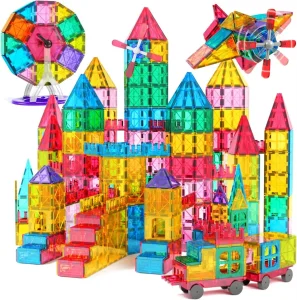
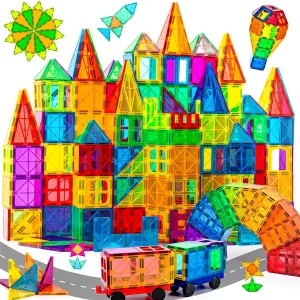
Historically, the magnetic toy market was dominated by static 2D planar tiles and rudimentary 3D geometric construction sets. However, consumer demand data from major retail networks in North America and Europe highlights an accelerating shift toward kinetic magnetic building systems. Integrating mobile wheel chassis bases—commonly known as magnetic tile cars—transforms stationary building blocks into interactive physics experimentation platforms. Children no longer merely construct static castles; they engineer functional vehicles, dynamic transport systems, and multi-tier roadway architectures.
This market evolution is further reinforced by global educational mandates prioritizing hands-on STEAM (Science, Technology, Engineering, Arts, and Mathematics) curricula. Educational institutions, early childhood development centers, and discerning parents seek toys that introduce fundamental concepts of kinetic friction, momentum, rotational force, and magnetic polarity matching. As a direct result, enterprise buyers must partner with manufacturers capable of maintaining exact mechanical tolerances across both plastic injection-molded components and integrated wheel assemblies.
Escalating CPSC and EU Toy Safety Directive enforcement demands ultra-secure magnetic retention. Free-floating magnet hazards are mitigated via double-sealed ultrasonic welding and internal mechanical encapsulation grid structures.
Global procurement heads prioritize standard 3-inch (76.2mm) pitch dimensions and standardized magnet placement centers to ensure seamless mechanical interlock with existing major market brand ecosystems.
Direct sourcing from specialized Chinese OEMs enables private-label brands to optimize bill-of-materials (BOM) costs while custom-engineering unique chassis geometry, colorways, and custom retail packaging.
A rigorous breakdown of key buyer requirements, margin analysis, risk mitigation strategies, and critical specifications for international wholesale magnetic tile car orders.
Enterprise procurement executives operating across tier-one retail chains, Amazon FBA brand conglomerates, and regional wholesale distribution channels face complex supply chain challenges. Sourcing magnetic tile cars requires a multi-faceted evaluation strategy that balances strict safety compliance against aggressive unit-cost targets and volume delivery schedules.
| Procurement Vector | Standard Market Level | Enterprise Grade (YuQi Factory Benchmark) | Impact on Business Performance |
|---|---|---|---|
| Magnet Alloy Grade | Recycled N30 / Low-flux Neodymium | Virgin N35 / N38 NdFeB Sintered Magnets | Prevents structural vehicle collapse during multi-story dynamic building plays. |
| Weld Seam Integrity | Single-pass ultrasonic perimeter weld | Dual-Chamber Ultrasonic Weld + Internal Ribbing | Eliminates magnet pop-out risks under drop-impact tests exceeding 2.0 meters. |
| Axle Architectural Design | Snap-fit friction plastic pins | Riveted 304 Stainless Steel Metal Axles | Provides smooth rotational velocity, zero wheel wobble, and high load capacity. |
| Plastic Polymer Base | Regrind ABS mix / Recycled scrap | 100% Virgin Non-Toxic Food-Grade ABS (BPA-Free) | Ensures high optical clarity, scratch resistance, and full compliance with REACH/CPSIA. |
| Defect Rate Allocation | 1.0% - 2.5% standard AQL | Strict AQL Level II (Critical: 0, Major: <0.65) | Dramatically lowers customer return rates and protects brand rating on e-commerce platforms. |
When executing high-volume purchase orders (50,000+ units per SKU), the primary risk vector revolves around structural fatigue in moving parts. Unlike standard static tiles, magnetic car bases feature integrated wheels subject to continuous mechanical friction, drop impacts, and lateral torsion. Sub-par factories often utilize low-cost plastic axles that snap under minimal stress or employ adhesive bonding instead of high-frequency ultrasonic welding.
To eliminate these critical vulnerabilities, top-tier Chinese manufacturers implement fully automated assembly lines where wheel axles are pressure-riveted into reinforced chassis slots prior to ultrasonic sealing. This structural locking mechanism ensures that even under severe physical abuse, the enclosed magnets remain completely inaccessible to children, fully satisfying CPSC 16 CFR Part 1262 safety directives.
An in-depth technical analysis of raw material selection, magnetics physical performance, automated ultrasonic sealing, and structural geometry optimization.
The operational performance of a magnetic tile car depends directly upon the magnetic flux density of its encapsulated elements. YuQi utilizes precision-grade Sintered Neodymium-Iron-Boron (NdFeB) N35 to N38 grade magnets. Each magnet undergoes custom multi-layer electroplating (Nickel-Copper-Nickel or anti-oxidation Epoxy coating) to eliminate internal corrosion risk even in humid maritime climates.
Furthermore, magnet dimensional tolerance is held strictly within ±0.05mm. Proper magnetic polarity alignment allows 360-degree free rotation inside the plastic retention pockets, enabling instant magnetic coupling regardless of orientation during building.
Adhesive bonding is strictly forbidden in high-grade toy manufacturing due to degradation over time. Our factory utilizes high-frequency 20 kHz ultrasonic welding technology with automated real-time acoustic energy feedback.
During the welding cycle, targeted acoustic energy melts the internal ABS plastic tongue-and-groove interface, fusing the top and bottom casing halves into a monolithic, seamless structural unit. This process yields a joint strength that exceeds international torque and tension thresholds by over 150%.
Navigating global toy safety directives requires rigorous, batch-verified laboratory testing. We supply full technical documentation dossiers for seamless customs clearance across all major international markets.
Full compliance with ASTM F963-17, CPSIA (Lead & Phthalates), and 16 CFR Part 1262 (Magnet Safety Standard). Flux Index testing confirms values remain well within safety thresholds while preserving structural connection strength.
Certified under EN71 Parts 1 (Mechanical/Physical), Part 2 (Flammability), Part 3 (Migration of Chemical Elements), REACH SVHC chemical directives, and UKCA / CE declaration of conformity.
Our production facilities operate under strict ISO 9001:2015 Quality Management Systems, with annual social accountability compliance under BSCI and SMETA 4-Pillar factory audits.
Every shipment is accompanied by complete test reports issued by accredited third-party testing laboratories (SGS, TÜV Rheinland, Intertek). We provide clear batch code traceabilities on both secondary packaging and primary master shipping cartons, guaranteeing friction-free import processing at customs checkpoints worldwide.
Explore our engineering pipeline for next-generation magnetic vehicle ecosystems, sustainable materials, and smart kinetic building technologies.
In response to global ESG mandates, our R&D team is pioneering bio-attributed ABS polymers synthesized from renewable plant residue sources. These materials deliver identical optical transparency, impact resistance, and sonic welding characteristics as traditional petroleum ABS while cutting product carbon footprint by up to 45%.
Our upcoming 2025 kinetic series integrates low-voltage wireless electromagnetic induction coils within magnetic car bases. When the magnetic tile car rolls across powered track tiles, ambient multi-color LED arrays illuminate automatically without requiring internal disposable batteries.
Direct technical and operational answers to common questions raised by enterprise buyers, brand managers, and logistics directors.
Browse additional certified magnetic building block and tile car configurations available for immediate OEM mass production.