Explore our top-tier precision-engineered magnetic tiles and cubes, tested to international standards for safety, durability, and max engagement.
The global educational toy sector is undergoing a profound paradigm shift driven by the expansion of early childhood STEM (Science, Technology, Engineering, and Mathematics) education, tactile sensory play requirements, and neuro-divergent learning adaptations. Among modern open-ended building mediums, magnetic cubes toys have emerged as the fastest-growing category within the wholesale toy distribution channel, exhibiting a compound annual growth rate (CAGR) projected to exceed 8.4% through 2030.
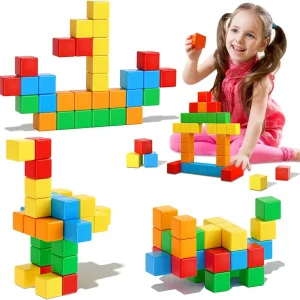
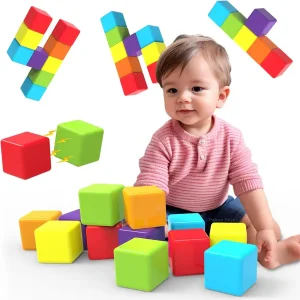
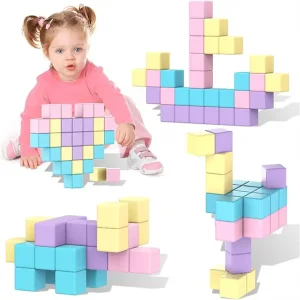
While classic flat magnetic tiles established the initial foundation for magnetic play, procurement data reveals a surging enterprise demand for six-sided 3D magnetic cubes. Unlike tiles that rely primarily on edge alignment, magnetic cubes feature internal rotational rare-earth magnets (Neodymium N35/N38 grades) encased in sealed compartments. This enables seamless omnidirectional polarity matching—allowing children to stack cubes along any axis without magnetic repulsion barriers.
Pediatric occupational therapists and STEM curriculum coordinators are increasingly adopting 1.42-inch magnetic cubes as foundational tools. The 1.42-inch (approx. 36mm) cube dimension is strategically engineered: it perfectly accommodates a toddler’s palm grip while exceeding the international Small Parts Test Cylinder (1.25 inches), eliminating choking hazards entirely for children aged 3 and above.
For enterprise toy buyers, Amazon FBA brand owners, and global retail chain importers, procuring magnetic toys involves navigating stringent consumer safety frameworks. Magnet ingestion hazards remain a top regulatory oversight area worldwide. Qualified manufacturers must demonstrate multi-tiered compliance infrastructure.
Cheap glued plastic joints deteriorate over time, risking internal magnet detachment. Professional factories utilize high-frequency (28 kHz) ultrasonic plastic welding processes. This fuses the ABS shell components into a singular structural matrix capable of withstanding impact pressures exceeding 150 lbs.
According to ASTM F963-17 and EN71-1, loose high-flux magnets pose extreme health risks if swallowed. Certified magnetic cube factories ensure that internal magnets remain permanently encapsulated, while maintaining total set flux index ratings well within safe legal thresholds (<50 kG²mm²).
All housing shells must use virgin, non-recycled ABS (Acrylonitrile Butadiene Styrene) plastic free from Phthalates, BPA, and heavy metal additives (Lead, Cadmium, Chromium). Material testing verified via ICP-MS testing confirms full compliance with REACH SVHC and CPSIA mandates.
China’s manufacturing ecosystem for magnetic toys has evolved far beyond low-cost labor. Today, leading facilities in Zhejiang (such as Yongkang industrial hubs) operate modern Industry 4.0 smart factories, offering global buyers unmatchable scalability, cost efficiency, and quality consistency.
Computerized mold-injection machinery operates with precision tolerance thresholds (±0.02mm). Automated robotic arms handle shell extraction and magnet positioning, preventing human error contamination and reducing unit assembly variance.
Centralized raw material clusters in China allow direct sourcing of premium NdFeB rare-earth permanent magnets and food-grade ABS resins at scale. This insulates global procurement managers from extreme raw material price volatility.
From custom Pantone color palettes (such as soft Macaron pastel tones) to custom structural molds, laser-etched branding, and retail-ready FSC paperboard boxes, China factories offer rapid prototyping within 7 to 10 working days.
When evaluating product lines for catalog inclusion, commercial buyers must weigh safety parameters, manufacturing costs, and target demographic suitability across different magnetic building mediums.
| Feature / Parameter | 1.42-Inch Magnetic Cubes | 2D Magnetic Tiles | Interlocking Plastic Blocks | Magnetic Rods & Steel Balls |
|---|---|---|---|---|
| Primary Age Target | Ages 3+ (Toddlers & Early STEM) | Ages 3+ (Preschool) | Ages 4+ to 12 | Ages 8+ to Adult (High Choke Risk) |
| Choke Hazard Safety | 100% Safe (Exceeds 1.25" Cylinder) | High (Large Flat Geometry) | Medium (Small Acc. Parts) | High Risk (Small Balls) |
| Magnet Enclosure Method | Ultrasonic 28kHz Sealed Shell | Ultrasonic Riveted Surface | N/A (Friction Snap Fit) | Exposed / Press-Fit |
| Magnet Grade Used | Neodymium N35 / N38 Rotational | Neodymium N35 Flat Bar | None | Neodymium N42 Bar |
| Drop Test Endurance | Passes 9-Ft Drop to Concrete | Passes 6-Ft Drop | Varies by Resin Quality | Moderate Shell Cracking Risk |
| 3D Spatial Versatility | Omnidirectional (6 Sides Connect) | Planar & 3D Shell Builds | Linear Vertical / Horizontal | Lattice Structural Wireframes |
Magnetic cubes serve as tangible manipulative models for teaching counting, color grouping, pattern sequencing, and basic spatial geometry. Educational suppliers bundle customized bulk sets (100-piece to 300-piece assortments) tailored for kindergarten classroom usage.
For online sellers on platforms like Amazon, Walmart, and Shopify, high-density magnetic cubes offer favorable weight-to-volume shipping ratios. Compact storage packaging minimizes FBA storage fees while enabling attractive retail markup margins.
The tactile feedback, subtle acoustic "click" of snapping magnets, and resistance free connection make magnetic cubes ideal for children with fine motor skill development challenges, autism spectrum needs, or occupational rehabilitation programs.
Browse our additional factory-direct catalog items optimized for international importers and STEM educational suppliers.