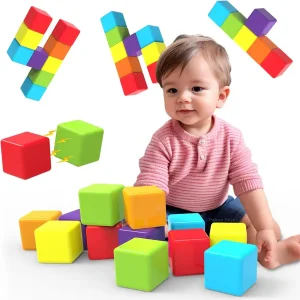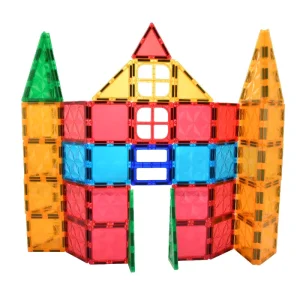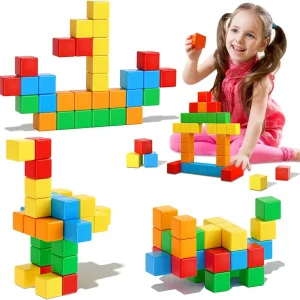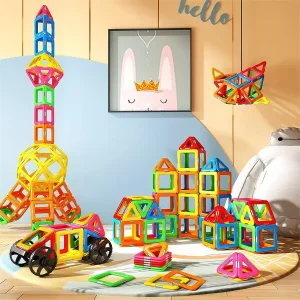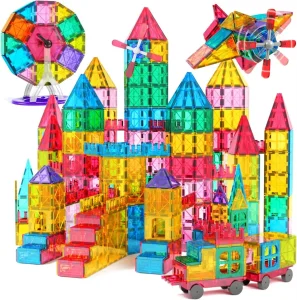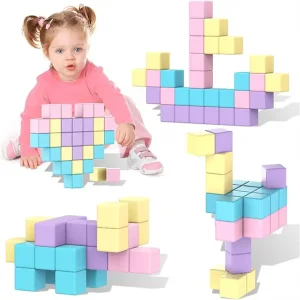
Explore our top-tier precision-engineered magnetic tiles, macro-cubes, and modular educational construction sets crafted for global distributors, educational brands, and high-volume commercial purchasers.
The global market for educational toys and construction blocks has underwent a radical structural paradigm shift over the past decade. Historically dominated by rigid, small-form interconnecting bricks, modern B2B buyers—ranging from educational institution supply chains to tier-one toy retail franchises—are rapidly prioritizing big building blocks, oversize magnetic tiles, and tactile macro-cubes. Driven by escalating parental emphasis on Science, Technology, Engineering, and Mathematics (STEM) learning and rigorous international safety directives regarding choke hazards, large format blocks represent one of the highest-growth categories within the global $100B+ toy industry.
Industrial data indicates that large-format building blocks (typically defined as individual structural components with minimum planar dimensions exceeding 1.4 inches or 36mm) are expanding at a compound annual growth rate (CAGR) of 8.4% globally. This structural pivot is primarily catalyzed by two macro trends: the widespread integration of spatial reasoning modules into early childhood education (ECE) frameworks, and the operational transition toward ultra-durable, easy-to-sanitize plastic polymers in public institutions.
Big building blocks manufactured by tier-one Chinese factories are engineered to service diverse commercial environments. Understanding localized deployment vectors enables B2B importers, brand owners, and procurement directors to optimize product specifications (such as polymer flexural modulus and magnetic flux density) for target end-users.
Early Childhood Education hubs utilize 1.42-inch magnetic cubes and oversized translucent tiles to teach toddlers spatial geometry, color mixing, and early architectural physics. The tactile feedback of sealed magnetic cores enhances motor control development without causing physical frustration.
High-traffic play zones requiring robust construction toys demand structural materials engineered for high impact. Heavy-duty ABS shells welded via high-frequency ultrasonic energy ensure that components withstand repeated drop impacts on hard venue floors without housing fracture.
Occupational therapists deploy magnetic macro-blocks to assist children with fine motor delay or sensory processing needs. The self-aligning nature of internal 360-degree rotating NdFeB magnets ensures successful connection regardless of magnetic polarity orientation.
To maintain competitive edge, leading OEM/ODM manufacturers are implementing sophisticated materials science and automated assembly infrastructure. Below is the technical evolution roadmap characterizing current and next-generation big building block manufacturing lines:
| Manufacturing Dimension | Legacy Manufacturing (Generation 1) | Current Factory Standard (Generation 2) | Future Technical Horizon (Generation 3) |
|---|---|---|---|
| Sealing Technique | Chemical Solvent Bonding / Glue Injection | Dual-Chamber Ultrasonic Perimeter Welding | Automated Laser-Assisted Hermetic Polymer Fusion |
| Magnet Core Technology | Fixed Ferrite Block Magnets | Encapsulated Cylindrical NdFeB (Neodymium) | Self-Orienting Spherical Multi-Axis NdFeB Arrays |
| Resin Material | Standard Recycled ABS Plastic | High-Impact Food-Grade Virgin ABS Polymer | Bio-Based Polycarbonate / Recycled Ocean Plastics |
| Quality Verification | Manual Batch Sampling Inspection | Inline Vision AI Defect Detection (CCD) | Full-Automated 100% CT Scan & Magnetic Flux Audit |
| Surface Finish | Glossy (Prone to Scratches) | Anti-Scratch Micro-Lattice Texture | Nanoscale Antimicrobial Hydrophobic Coating |
The key structural failure point in sub-standard building blocks is shell separation, which can liberate small internal magnets—presenting severe regulatory and biological hazards. Premier China factories deploy high-frequency ultrasonic transducers operating at 20 kHz to 35 kHz. This mechanical vibration friction melts plastic contact joints at a molecular level, creating a unified monolithic lattice. The resulting weld seam boasts tensile strength exceeding international toy safety demands by over 300%.
China’s manufacturing ecosystem—specifically centered around advanced industrial clusters in Zhejiang (such as Yongkang and Jinhua)—delivers unmatched operational capabilities for global B2B buyers sourcing big building blocks. The concentration of upstream raw material suppliers, precision mold-making workshops, ultrasonic machinery builders, and export logistics hubs within a 50-mile radius creates an unparalleled competitive moat.
China factories maintain in-house CNC mold-making departments capable of cutting high-precision hardened steel injection molds within 15 to 21 days. This rapid prototyping velocity empowers brand owners to launch custom block geometries ahead of seasonal retail windows.
With China controlling over 70% of global rare-earth element processing, domestic toy factories secure high-coercivity Neodymium (NdFeB) magnets at lower material unit costs, guaranteeing consistent magnetic hold strength without cost inflation.
Modern assembly lines utilize multi-axis robotic arms for automated magnet placement into injection molded cavities prior to ultrasonic sealing, yielding daily outputs exceeding 50,000 units per line with near-zero error rates.
Navigating international consumer safety legislation is critical for importers distributing building blocks across North America, the European Union, and Asia-Pacific. Reliable wholesale manufacturers act as compliance partners, supplying comprehensive testing dossier bundles certified by accredited third-party laboratories (such as SGS, TÜV Rheinland, and Intertek).
Beyond chemical and mechanical safety, professional manufacturers assist enterprise clients with localized packaging redesign, custom retail box structural optimization for reduced drop-shipping damage, specialized retail-ready point-of-sale display trays, and streamlined customs tariff classification (HS Code: 9503.00.0000).
Standard factory MOQs for off-the-shelf color formulations start at 500 to 1,000 sets. For fully customized pantone color matching, custom mold geometries, or private-label retail packaging, the typical baseline MOQ ranges from 2,000 to 3,000 sets depending on set complexity.
Top-tier manufacturers implement a double-containment strategy: magnets are positioned inside internal structural plastic columns, which are then completely enclosed within an outer ABS shell. The outer seam undergoes continuous high-frequency ultrasonic welding. Final production units undergo 10-meter drop tests and 50N tensile pull stress testing to verify absolute structural integrity.
Yes. Premier suppliers employ dedicated R&D engineering teams that collaborate with clients to design proprietary shapes, functional action components (such as magnetic wheelbases, ramps, and light-up LED blocks), and accompanying step-by-step STEM activity guidebooks.
Standard reorders take approximately 20 to 25 calendar days upon deposit receipt. Initial OEM orders requiring custom mold tooling require 35 to 45 days total (20 days for tool creation and testing, followed by 20 days for mass production and safety certification verification).
Browse our full catalog of factory-direct magnetic building blocks, toddler safety cubes, and 3D STEM construction tiles ready for worldwide shipment.