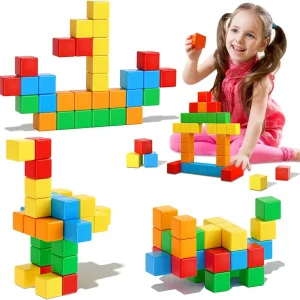
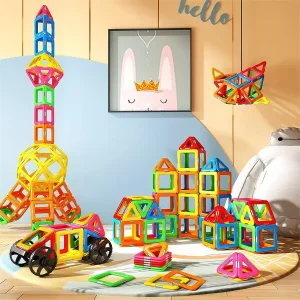
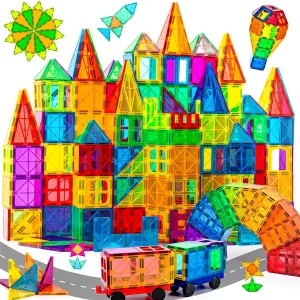
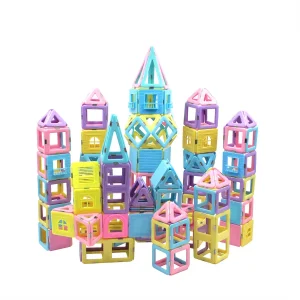
In the rapidly evolving landscape of Science, Technology, Engineering, and Mathematics (STEM) educational play media, Magnetictile Builders have transitioned from niche sensory products into foundational mainstays of early childhood cognitive development worldwide. Market data indicates that the global magnetic building toy market is expanding at a Compound Annual Growth Rate (CAGR) exceeding 8.4%, driven by surging institutional adoption in preschools, Montessori environments, and home-schooling frameworks across North America, Western Europe, and the Asia-Pacific region.
At the epicenter of this global production volume is China's advanced toy manufacturing cluster—primarily concentrated in Zhejiang (Yongkang, Jinhua) and Guangdong provinces. Chinese manufacturers produce upwards of 85% of the global supply of magnetic building tiles, cubes, and blocks. This dominance is not merely a reflection of cost competitiveness, but rather the result of deep industrial clustering, automated ultrasonic welding technology, rigorous material compliance, and sophisticated magnetics engineering.
Evaluating China's manufacturing ecosystem for magnetictile builders requires understanding the complete vertical integration present in specialized industrial zones like Yongkang. Unlike fragmented regional producers elsewhere, Chinese factories benefit from an integrated supply chain that spans raw material refinement, magnetic alloy sintering, high-precision injection molding, automated ultrasonic sealing, and international certification logistics within a 50-kilometer radius.
Top-tier Chinese manufacturers utilize 100% virgin, non-toxic ABS (Acrylonitrile Butadiene Styrene) plastic. This ensures optical transparency, rich color saturation, zero heavy metals, and high impact resistance to withstand drop tests without shattering.
China controls over 70% of global Neodymium (NdFeB) permanent magnet production. Local toy factories leverage direct access to high-coercivity N35, N38, and N40 grade magnets, offering optimal magnetic pull force without adding excess weight.
High-volume factories employ dual-chamber ultrasonic welding machinery. High-frequency acoustic vibrations fuse plastic shell edges seamlessly at a molecular level, preventing magnet dislodgement and eliminating solvent-based glues.
Rapid CNC tooling and mold construction permit lead times for custom tile designs (e.g., lattice windows, curved tracks, custom geometries) to be reduced from months to under 20 days at a fraction of Western tooling costs.
Child safety remains the paramount operational risk in the magnetic toy segment. Small, high-powered magnets present severe internal ingestion hazards if loose. Leading Chinese Magnetictile Builder manufacturers enforce strict internal structural engineering and automated multi-stage inspection regimes to mitigate these risks.
First-generation magnetic tiles relied solely on perimeter ultrasonic seals, which under extreme drop force could split along bond lines. Modern high-tier Chinese factories employ a multi-layer defense strategy:
Enterprise buyers must verify compliance across multiple target export regions. Reputable Chinese factories hold comprehensive test reports issued by ILAC-MRA accredited third-party laboratories (SGS, TUV, Intertek, BV).
| Regulatory Standard | Jurisdiction | Core Technical Test Focus | Compliance Threshold |
|---|---|---|---|
| ASTM F963-23 | United States | Magnet flux index, use & abuse, tension/impact testing | Flux index < 50 kG² mm² for loose magnets; zero detachment |
| EN71 (Parts 1, 2, 3) | European Union | Mechanical safety, flammability, heavy metal migration | Strict limits on 19 soluble elements; mechanical torque test |
| CPSIA / CPSC | United States | Total lead content, phthalates (8 restricted plasticizers) | Lead < 90 ppm, Phthalates < 0.1% (1000 ppm) |
| ISO 8124 | International / AU / NZ | Small parts hazard, magnetic strength force evaluation | Impact drop from 1.5m onto steel plate without magnet exposure |
| CCC (GB 6675) | China domestic | National Toy Safety Technical Code specification | Mandatory certification for domestic distribution and import |
Understanding end-user application contexts enables brand owners and importers to curate specific set configurations (piece counts, color themes, specialized accessory tiles) tailored to regional consumer demand.
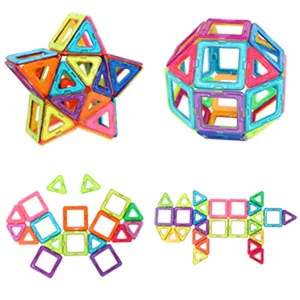
Educational institutions utilize clear, primary-colored magnetic tiles to teach 2D to 3D spatial geometry, symmetry, fractional mathematics, and basic structural engineering principles through tactile construction.
The audible "click" of magnetic polar alignment and the tactile feel of smooth ABS surfaces offer valuable sensory feedback for children with Autism Spectrum Disorder (ASD) and fine-motor developmental delays.
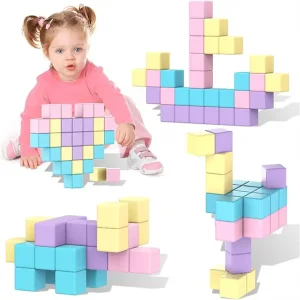
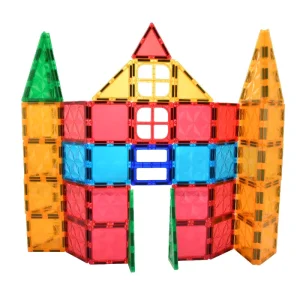
Mass-market retail sets emphasize open-ended play, featuring expansion packs with marble runs, car bases, light-up LED cubes, and castle architecture themes in vibrant pastel and macaron color palettes.
For global brand managers, Amazon FBA sellers, and chain store procurement officers, selecting the optimal factory partner involves evaluating complete turnkey capabilities—from initial CAD prototyping to optimized container stuffing.
Leading Chinese manufacturing hubs provide robust white-label and private-label customization channels designed to maximize brand equity and retail differentiation:
Direct factory sourcing in China offers significant margin optimization for global distributors. The breakdown below illustrates a typical factory-direct bill of materials (BOM) cost distribution for high-grade magnetic tile production:
Sourcing high-coercivity N35/N38 rare-earth magnetic alloys represents the single largest direct component cost.
High-transparency food-grade resin engineered for impact resistance, clarity, and structural weld strength.
Precision injection molding, ultrasonic welding cycle time, rivet insertion, and automated quality testing.
Retail box construction, drop test verification, inner blister trays, and master carton shipping prep.
The Chinese Magnetictile Builder manufacturing sector is rapidly upgrading towards sustainable, smart, and interactive building platforms. Key industry shifts include:
Leading suppliers are developing ISCC-certified bio-attributed plastics derived from renewable feedstocks, minimizing carbon footprint while maintaining strict ASTM/EN71 safety compliance.
Integration of low-voltage inductive power circuits and micro-LED components into magnetic tile edges, enabling child constructions to illuminate automatically upon magnetic contact.
Standardizing magnetic node spacing to allow hybrid play between 2D magnetic tiles, 3D magnetic cubes, structural wooden blocks, and standard brick building systems.