Explore factory-direct magnetic tiles, 3D educational construction cubes, and STEM-certified building block sets engineered for global retail networks, institutional procurement, and custom private-label branding.
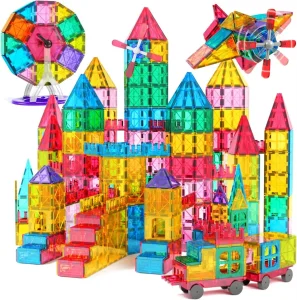

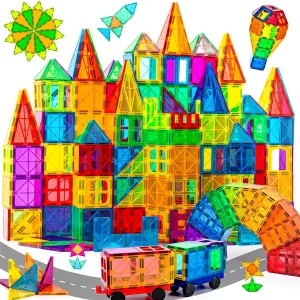
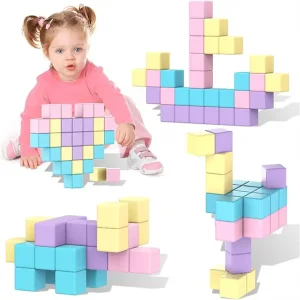
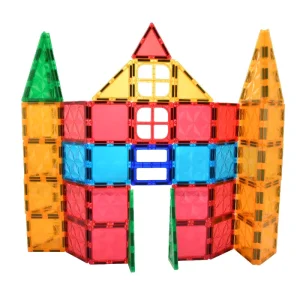
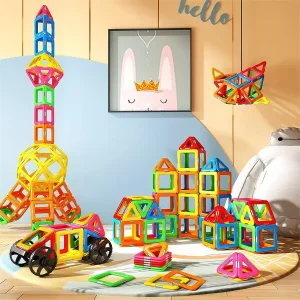
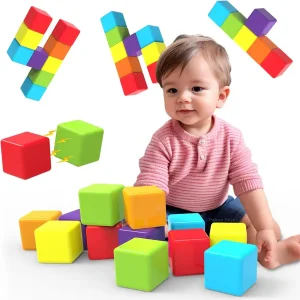
Analyzing the shifting economics, raw material reliance, and strategic manufacturing clusters defining the global buildable magnetic toy sector.
The international educational toy sector is undergoing a profound paradigm shift. Driven by early childhood STEM/STEAM education initiatives, the global market for buildable magnetic toys and structural geometric tiles is projected to expand at a compound annual growth rate (CAGR) exceeding 8.4% through 2030. Within this expanding landscape, China accounts for over 85% of global production output. This dominance is not merely a matter of labor capacity; it stems from deep vertical integration across rare-earth refining, precision injection tooling, automated ultrasonic assembly, and international safety compliance infrastructure.
China’s manufacturing prowess in buildable magnetic toys is geographically concentrated in industrial hubs such as Yongkang and Ningbo in Zhejiang province. These clusters provide an unmatched micro-supply chain ecosystem:
For global B2B buyers—including brand owners, retail chains, and educational procurement groups—sourcing buildable toys from premier Chinese suppliers requires navigating complex logistics and regulatory barriers. Leading Chinese manufacturing plants have evolved beyond simple OEM (Original Equipment Manufacturing) contract work. They now offer full-scale ODM (Original Design Manufacturing) solutions, providing end-to-end supply chain visibility, tariff-optimized HS code classification (e.g., HS 9503.00.00), and automated packaging lines tailored for Amazon FBA or traditional brick-and-mortar retail channels.
An in-depth look at structural physics, double-encapsulation safety mechanisms, and next-generation smart manufacturing processes.
The primary engineering challenge in buildable magnetic toys lies in balancing magnetic structural integrity with strict swallow-hazard containment protocols. Loose or exposed magnets present severe medical risks if ingested by young children. Consequently, Tier-1 Chinese suppliers employ advanced mechanical encapsulation and testing methodologies.
Instead of relying on chemical adhesives that degrade under thermal or mechanical stress, modern factories use 20 kHz / 3000W high-frequency ultrasonic welding equipment. This fuses the ABS plastic shells at a molecular level, creating a permanent, tamper-proof seal capable of enduring impact forces exceeding 50 lbs (220 N).
Using Finite Element Analysis (FEA), buildable tiles are engineered with internal reinforcement columns and diagonal ribbing networks. This lattice structure redistributes drop impacts across the perimeter frame, preventing shell cracking even during repetitive 1.5-meter drop tests onto hard concrete substrates.
To provide 360-degree rotation and instant connection without magnetic repulsion, cylindrical NdFeB magnets are encased within dedicated inner floating channels. This dual-chamber design allows 360° free rotation while physically isolating the magnet from external edge friction.
Implementation of 4K vision AI cameras on assembly lines to instantly reject tiles with microscopic weld voids, color variations ($\Delta E > 0.5$), or magnet displacement.
Transitioning from petroleum-derived ABS to eco-friendly, bio-based resin compounds derived from plant starches, matching traditional ABS impact resistance while cutting carbon footprints by 40%.
Integrating passive micro RFID microchips inside magnetic blocks to enable interactive tablet app integration, allowing children to digitize their physical builds into 3D models.
Closed-loop industrial recycling framework allowing 100% reclamation of post-consumer plastic and magnetic cores through automated mechanical separation.
A definitive comparison of mandatory international toy safety standards governing buildable magnetic products across major destination markets.
For commercial importers, non-compliance with regional toy safety directives can result in severe legal penalties, product recalls, and customs seizures. Top-tier Chinese manufacturers operate dedicated internal testing laboratories accredited by CNAS (China National Accreditation Service) and third-party bodies such as SGS, TÜV Rheinland, and Intertek.
| Regulatory Standard | Target Region | Key Testing Parameters | Compliance Thresholds |
|---|---|---|---|
| ASTM F963-23 | United States | Clause 4.39 (Magnet Safety), Heavy Metals (Soluble 8 Elements), Sharp Edges/Points | Flux Index < 50 kG²mm² for loose magnets; zero detachment after 10-cycle drop test. |
| EN71 (Parts 1, 2, 3) | European Union (CE) | Mechanical/Physical Properties, Flammability, Migration of 19 Heavy Elements | Strict organic tin and lead migration limits (<2.3 mg/kg Lead); zero small part release under 90N tension. |
| CPSIA / CPSC | United States | Total Lead Content, Phthalate Plasticizers (8 Restricted Phthalates) | Total lead content in substrate < 100 ppm; phthalates (DEHP, DBP, BBP, etc.) < 0.1% (1000 ppm). |
| ISO 8124 (Parts 1-4) | International / AU / NZ | Mechanical Hazards, Magnet Strength Limits, Toxicological Safety | Harmonized global standard limiting flux index and requiring high-stress impact survival. |
| EU Directive 2009/48/EC | European Economic Area | EC Declaration of Conformity, Chemical Safety Assessment (CSA), Micro-Biological Safety | Requires full supply chain traceability, batch number laser engraving, and chemical dossier retention. |
Raw virgin ABS resins undergo Inductively Coupled Plasma Mass Spectrometry (ICP-MS) testing to verify zero heavy metal migration (Antimony, Arsenic, Barium, Cadmium, Chromium, Lead, Mercury, and Selenium).
Samples are conditioned in environmental chambers at 60°C and 90% RH for 168 hours before undergoing torsional load tests (0.45 Nm) to guarantee weld joint stability under extreme shipping conditions.
Tier-1 Chinese factories maintain ISO 9001 (Quality Management), ISO 14001 (Environmental), and ethical social audits including BSCI, SMETA (4-Pillar), and ICTI CARE certifications.
How magnetic buildable toys are deployed across diverse global channels—from institutional classrooms to high-margin retail private labels.
In North America and Europe, educational institutions integrate buildable magnetic tiles into kindergarten curricula. Children visually master geometry (2D-to-3D net transformations), spatial reasoning, and basic magnetic physics through open-ended constructivist play. Bulk classroom packs featuring reinforced edge tiles are designed specifically for heavy institutional usage.
Pediatric therapists utilize 1.42-inch large magnetic cubes and macaron soft-palette tiles for neurodivergent children and toddlers developing fine motor control. The auditory "click" of snapping magnets provides immediate tactile feedback, facilitating sensory integration and hand-eye coordination without frustration.
For Amazon sellers and boutique toy brands, Chinese factories offer specialized OEM packaging solutions. These include custom Pantone color matching (e.g., pastel, crystal clear, or metallic series), custom-printed storage boxes, localized instruction booklets, and barcode labeling ready for instant ocean or air fulfillment.
A structured 5-step operational pipeline illustrating how leading Chinese suppliers transition a client concept into mass-produced, market-ready buildable toys.
Initial 3D STP/IGS design rendering. Engineers execute Finite Element Analysis to optimize wall thickness, magnet positioning, and drop-stress distribution before steel tooling cut.
Machining of P20 or 718H hardened steel molds guaranteed for 500,000 to 1,000,000 injection cycles. Micro-textured cavity surfaces create scratch-resistant plastic finishes.
High-speed fully automated injection machines mold food-grade virgin ABS resin blended with light-fast non-toxic color masterbatches matching target Pantone codes.
Robotic arms insert polarity-aligned NdFeB magnets into internal channels, followed by instant 20kHz ultrasonic sealing and automated optical defect extraction.
Batch-level drop and tension testing, followed by issuing COC/COA documents, custom retail packaging assembly, palletization, and DDP/FOB global shipment.
Ongoing regulatory monitoring, ensuring continuous update of laboratory test dossiers for evolving EU Safety Directives or US CPSC mandatory revisions.
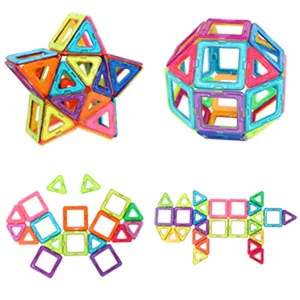
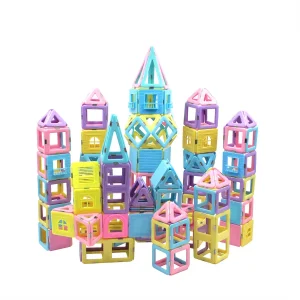
Discover toddlers' magnetic cubes, macaron-tinted girls' building sets, and high-capacity educational tiles tailored for high-volume wholesale ordering.
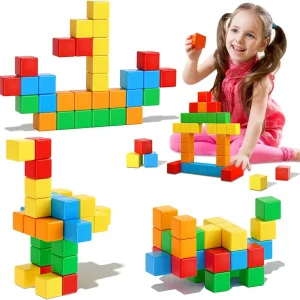
Direct, authoritative answers addressing procurement, compliance, factory audits, and engineering standards for global buildable toy buyers.
Tier-1 factories utilize high-frequency 20kHz ultrasonic welding equipment combined with internal dual-wall plastic retention cages. Instead of chemical gluing, the ABS plastic housing is melted at a molecular level around the magnet chamber. This structural design guarantees that even if the outer plastic housing experiences extreme drop forces (e.g., 50 lbs or 1.5m impact tests), the magnet remains sealed within an inner isolation pod, passing ASTM F963-23 Clause 4.39 and EN71-1 pull tests completely.
For custom OEM/ODM shapes, 3D CAD modeling and prototype sampling require 5 to 7 working days. Precision steel mold fabrication (P20/718H steel) typically takes 25 to 35 calendar days. Color matching using custom Pantone masterbatches requires 3 to 5 days. Once molds are approved, mass production capacity averages 10,000 to 20,000 sets per week per automated production line.
Quality suppliers utilize N35 or N38 grade Neodymium magnets rated for maximum operating temperatures ($T_{max}$) of 80°C (176°F) with high intrinsic coercivity ($H_{cj} > 12\text{ kOe}$). Because ocean container temperatures rarely exceed 60°C during transit, the magnetic remanence ($B_r$) suffers zero irreversible demagnetization loss, retaining 100% of its magnetic holding force upon arrival at global destination ports.
Importers require a complete compliance package consisting of: (1) Children’s Product Certificate (CPC) for North America or EC Declaration of Conformity (DoC) for Europe; (2) Third-party test reports from accredited labs (SGS/TÜV/Intertek) verifying ASTM F963-23, CPSIA (lead/phthalates), and EN71 Parts 1-3; (3) Factory ISO 9001 quality certificates; and (4) Toxicological Risk Assessment (TRA) reports for polymer dyes.
International standards (ASTM F963 and EN71) mandate that any magnet small enough to fit inside the small parts cylinder must have a Flux Index below 50 kG²mm² ($5.0 \times 10^{-4}\text{ T}^2\text{mm}^2$). Chinese factories test every magnetic batch using digital Gaussmeters and polarimeters to calculate the flux density multiplied by the pole area, guaranteeing strong structural buildability while staying safely beneath mandatory hazard thresholds.
Standard factory MOQs for catalog products in factory-standard color boxes are typically 100 to 300 sets. For custom private-label artwork, customized Pantone plastic colors, and branded retail color boxes, the MOQ is usually 1,000 sets due to automated printing press setup costs and color batch compounding minimums. Flexible tiered pricing applies to 20ft and 40ft high-cube container volumes.