Magnetic Play Blocks bring a satisfying mix of building, movement, and early engineering into children’s hands. A flat tile can become a bright window, while a ball-and-stick set can form a flexible bridge. These simple transformations make construction feel immediate and rewarding. They also encourage children to test balance, symmetry, size, and shape through direct play.
The top types usually include magnetic tiles, magnetic sticks and balls, 3D block sets, and magnetic marble-run systems. Magnetic tiles suit young builders who enjoy houses, towers, and colorful patterns. Sticks and balls offer more open-ended structures, especially for children exploring joints and angles. Three-dimensional blocks create fuller models with depth. Marble-run sets add motion, although they often demand more patience and careful alignment.
Choosing the right type depends on age, motor skills, interests, and available space. During a practical comparison, tile sets often feel easier to start, while stick systems can provide greater design freedom. That judgment is not absolute. Some children prefer repeatable patterns over complicated models. Adults should check age guidance, magnet security, material information, and independent safety testing before purchase. Strong magnets require careful supervision, particularly around younger children. A thoughtful guide should also consider connector strength, edge smoothness, storage, and the clarity of building instructions. The best set is not always the largest one. It is the set that invites safe experimentation, survives ordinary use, and keeps children asking, “What can I build next?”
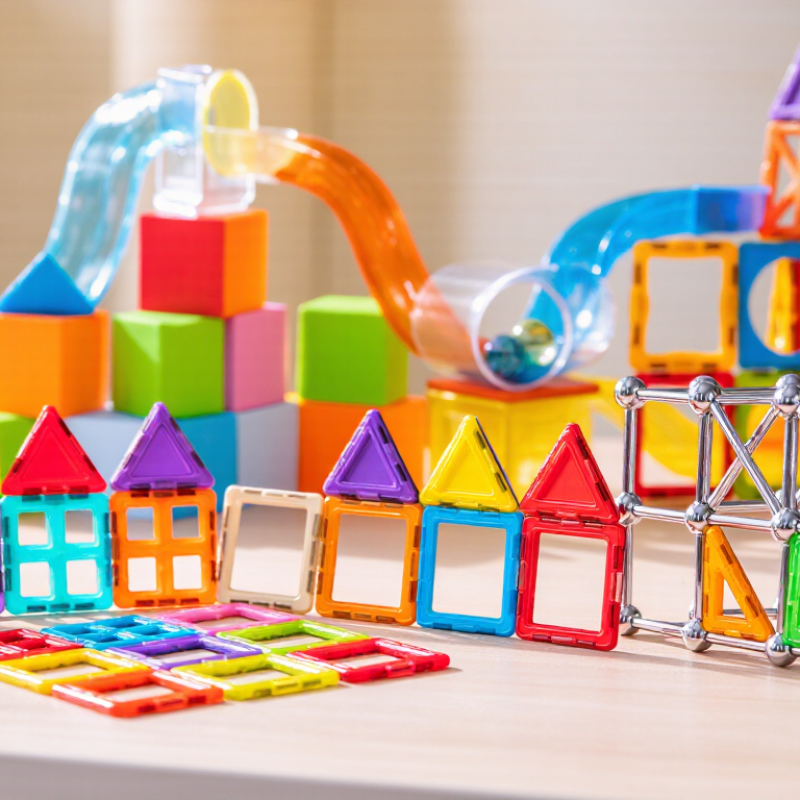
Magnetic play blocks are construction toys that use embedded magnets to connect separate pieces. Children can build, pull apart, and rebuild without glue or complicated tools. Their core feature is controlled magnetic attraction, usually placed along edges, corners, or inside connecting bars. This simple mechanism supports open-ended play and makes structural ideas easier to see.
Common types include flat magnetic tiles, magnetic sticks with connector balls, and solid geometric blocks. Tiles create walls, roofs, windows, and colorful patterns. Sticks and balls encourage frames, towers, and more flexible shapes. Solid blocks feel heavier and may suit children who prefer stacking and handling. In practice, each format teaches balance differently. A tall tower can lean, twist, or collapse suddenly.
Good magnetic play blocks should have smooth edges, durable surfaces, and magnets sealed securely inside each piece. Strong connections help, but excessive force is not always useful. Children need to understand why a structure fails. Adults should check pieces regularly for cracks, loose parts, or damaged coverings, especially when younger children are nearby. Age guidance matters because loose magnets can create serious health risks if swallowed. I once assumed stronger magnets always meant better play. That was too simple. Balanced pieces, clear shapes, and manageable weight often create more thoughtful building. The best sets invite experimentation while keeping the building process visible, tactile, and easy to revise.
Magnetic play blocks usually begin with flat squares, equilateral triangles, and narrow rectangles. Squares create walls, floors, and simple window frames. Triangles add strength and help builders form roofs, pyramids, and angled supports. Rectangles extend bridges or make longer sides without adding many pieces. These shapes teach balance through touch, not theory.
During hands-on building, children often discover that larger structures need repeated patterns. A square may stand alone, but several connected shapes distribute weight more evenly. Basic magnetic blocks also include solid cubes, curved pieces, rods, and magnetic balls. Cubes suit compact towers, while rods and balls support more open, skeletal designs. Curved blocks are useful for arches, wheels, and rounded shelters.
The exact magnetic strength can differ between sets, so connection quality should be tested gently. I have found that children sometimes expect magnets to hold any design, even when the angle creates too much strain. That mistake is useful. It encourages slower building and careful observation. Keep it simple.
Adults should check that magnets remain sealed and intact, especially when younger children are playing. Loose magnets can cause serious internal injuries if swallowed, so damaged pieces require immediate removal. Age guidance, piece size, and supervision should shape the choice more than appearance alone.
Specialized magnetic blocks turn ordinary construction play into a small design studio. Connector blocks suit frames, bridges, and moving structures, while geometric panels create walls, roofs, windows, and colorful facades. Rod-and-ball systems offer more flexible angles, making them useful for models of towers, insects, or simple machines.
Good magnetic blocks should connect firmly but separate without excessive force. Strong connections matter when children build tall shapes, yet predictable release helps prevent frustration. Check that magnets remain fully enclosed and inspect every piece for cracks before use. Follow the recommended age range, especially around younger children.
Design becomes more interesting when builders combine structure with purpose. A wide base can support a curved roof. Repeated triangles can strengthen a tower. Transparent panels can suggest light, even when the room stays dim. Small details matter.
Do not trust appearance alone.
A practical test is to build a 20-centimeter tower and gently tap the table. If it collapses immediately, the design needs a broader base or fewer upper layers. My first imagined layouts often look impressive but ignore balance, weight, and access. That is the useful mistake. Specialized blocks teach that attractive forms still need sound planning, and even experienced builders should revise their ideas after testing them.
| Magnetic Block Type | Common Geometry | Primary Building Uses | Key Design Strength | Typical Limitations | Recommended For | Design Versatility |
|---|---|---|---|---|---|---|
| Square Tiles | Flat square panels with magnetic edges | Walls, floors, simple buildings, grids, boxes, and larger flat surfaces | Easy to align and highly effective for creating stable rectangular structures | Flat walls can become flexible if the structure lacks diagonal or triangular support | Beginners, classrooms, room layouts, and architectural foundations | ★★★★★ |
| Equilateral Triangles | Three-sided panels with equal-length sides | Roofs, domes, pyramids, geometric sculptures, and structural reinforcement | Triangles provide strong geometric bracing and help prevent rectangular frames from shifting | Less suitable than squares for covering broad rectangular walls | Engineering challenges, 3D structures, and advanced geometry projects | ★★★★★ |
| Right Triangles | Three-sided panels containing a 90-degree angle | Sloped roofs, corner supports, ramps, stair-like designs, and irregular layouts | Connects rectangular and triangular forms while supporting angled construction | Usually works best as a complementary piece rather than a stand-alone building set | Detailed architectural models and problem-solving activities | ★★★★☆ |
| Isosceles Triangles | Three-sided panels with two equal sides | Peaked roofs, towers, arrow shapes, symmetrical patterns, and decorative façades | Creates balanced designs and adds visual variety to standard square-based structures | May require additional shapes to form complete floors or enclosed rooms | Symmetry exercises, creative design, and decorative construction | ★★★★☆ |
| Equilateral Rhombi | Four-sided diamond-shaped panels with equal sides | Curved-looking walls, repeating patterns, faceted towers, and artistic structures | Produces diagonal surfaces and more complex silhouettes than standard squares | Can be more difficult to align into conventional rectangular buildings | Pattern design, geometry exploration, and nontraditional architecture | ★★★★☆ |
| Window Panels | Square or rectangular frames with transparent centers | Windows, skylights, greenhouses, display cases, and open-view buildings | Introduces light, visibility, and interior detail without changing the overall structure | Open centers provide less solid surface area and may not be suitable for load-bearing sections | Role-play settings, architectural models, and visual storytelling | ★★★★☆ |
| Curved or Arc Pieces | Curved panels, arches, or rounded connectors | Bridges, tunnels, domes, arches, wheels, circular towers, and organic forms | Allows rounded profiles that are difficult to create with straight-edged tiles alone | Often requires several matching pieces to complete a stable circular or arched form | Advanced builders, transportation models, and sculptural design | ★★★★★ |
| Connector Pieces | Magnetic joints, hubs, rods, or multi-angle links | Frames, articulated models, bridges, moving mechanisms, and skeleton structures | Supports multiple connection angles and expands the range of possible frameworks | Open-frame models may be less suitable for enclosed walls or smooth surfaces | Engineering concepts, mechanical models, and flexible construction | ★★★★★ |
| Wheels and Axle Components | Round wheels with compatible axle or connector parts | Cars, carts, trains, rotating displays, and mobile prototypes | Adds movement and encourages exploration of balance, motion, and simple machines | Rolling performance depends on a level surface, balanced construction, and compatible connectors | Vehicle design, STEM activities, and interactive play | ★★★★☆ |
| Large Structural Panels | Oversized squares, rectangles, or reinforced flat panels | Large walls, room dividers, life-size play spaces, and rapid model construction | Covers more area with fewer pieces and speeds up the construction of large forms | Requires adequate support at joints; larger surfaces can flex or tip if poorly braced | Collaborative play, exhibitions, and large-scale design activities | ★★★★☆ |
What Are the Top Types of Magnetic Play Blocks?
Educational Benefits of Different Magnetic Block Types
Magnetic tiles are useful for early spatial learning. Children join bright squares, triangles, and windows into houses or bridges. This hands-on process supports shape recognition, symmetry, and basic geometry. The OECD’s PISA 2022 assessment measured creative thinking across 64 countries and economies. Its findings highlight the value of activities requiring original ideas and problem solving. Magnetic tiles offer a simple setting for both skills.
Rod-and-sphere blocks encourage structural thinking. Children test whether a long beam can support a roof or tower. The result may collapse. That failure is educational. It encourages prediction, adjustment, and persistence. Panel-based blocks add another layer. Children can create walls, tunnels, or animal habitats, then explain their designs through pretend play. The American Academy of Pediatrics identifies play as important for executive function, language, and social development. However, magnetic blocks do not automatically produce these outcomes. Adult questions matter. “Why did it fall?” works better than giving instant instructions.
Different block types suit different learning moments. Tiles often support visual planning, while rods develop balance and connection logic. Larger panels may help children collaborate around one shared structure. A 2018 UNICEF and LEGO Foundation report describes play as active, engaging, meaningful, and socially interactive. Those conditions depend on the environment, not only the toy. Children need open-ended time, safe materials, and room to revise ideas. Some sets may feel too difficult at first. That is not always a weakness. It can reveal where guidance, simpler shapes, or more patient practice are needed. Always check age guidance and magnet safety standards before classroom or home use.
Educational Benefits of Different Magnetic Block Types
The scores use a transparent 1–5 learning-affordance scale based on the physical characteristics of each block type. Flat tiles emphasize geometry and spatial reasoning, rod-and-ball sets support structural design, magnetic sheets encourage pattern-making and flexible construction, and magnetic cubes provide hands-on practice with symmetry and three-dimensional building.
Start with the child, not the box. For ages 1–2, choose large magnetic tiles with fully enclosed magnets, thick plastic, and rounded edges. Avoid pieces that can crack, split, or detach. At this stage, children usually explore by mouthing and dropping toys. Watch the hands.
The U.S. Consumer Product Safety Commission reported more than 2,400 emergency-room cases involving high-powered magnet ingestion from 2010 to 2021. It also recorded seven deaths worldwide. This data makes magnet security more important than colorful designs. For preschoolers aged 3–5, select medium-sized blocks with simple shapes and clear age labeling. Supervision still matters, especially during group play. A single damaged piece can change the risk quickly.
Children aged 6 and above may use smaller connectors, wheels, and engineering-style components. These sets support planning, balance, and spatial reasoning. However, complexity should grow gradually. The American Academy of Pediatrics recommends checking toy size, construction quality, and developmental suitability before purchase. ASTM F963 also includes safety requirements for magnets in toys sold in the United States. Age labels are useful, but they are not perfect. A careful adult should inspect seams, test magnetic strength, and remove damaged pieces immediately. I would rather offer fewer durable blocks than a large set with questionable parts.
They are construction pieces with sealed magnets inside their edges or connectors. Children can build, separate, and rebuild without glue or tools.
Squares make walls, floors, and windows. Triangles support roofs, pyramids, and angled structures. Rectangles extend bridges and longer sides.
Flat tiles suit walls and colorful patterns. Rods with connector balls create frames and towers. Solid cubes feel heavier and support compact stacking.
Look for smooth edges, durable surfaces, and securely enclosed magnets. Choose pieces that match the child’s age and handling ability. Appearance is not enough.
Choose large tiles with thick plastic, rounded edges, and fully sealed magnets. Avoid pieces that crack, split, or detach. Watch the hands.
Children aged three to five may use medium-sized blocks with simple shapes. Clear age labeling helps, but supervision remains important during group play.
Children aged six and above may use smaller connectors, wheels, and engineering-style pieces. Complexity should increase gradually. Bigger challenges can still fail suddenly.
Swallowed magnets can cause serious internal injuries. Safety reports recorded over 2,400 emergency-room cases involving high-powered magnet ingestion from 2010 to 2021. Remove damaged pieces immediately.
Let them examine the weak angle, uneven weight, or strained connection. A failed tower can teach balance better than constant success. I once thought stronger magnets solved everything. That idea was too simple.
Magnetic Play Blocks are construction toys made from pieces that connect through built-in magnets, allowing children to create structures without complicated instructions or tools. Their main features include easy attachment, colorful designs, reusable components, and the ability to support both flat patterns and three-dimensional models. Common types include magnetic squares, triangles, rectangles, and other geometric shapes, while specialized pieces such as wheels, windows, arches, connectors, and curved elements can add movement, detail, and new design possibilities.
Different magnetic block types can support learning in practical and creative ways. Children may develop spatial awareness, fine motor skills, problem-solving abilities, early geometry knowledge, and imaginative thinking while building and rebuilding. When choosing Magnetic Play Blocks, consider the child’s age, the size and strength of the pieces, the complexity of the designs, and the ease of handling. Younger children generally benefit from larger, simpler blocks, while older children may enjoy smaller sets with more shapes and advanced construction options.