+86 151 5899 3225 [email protected] Yongkang, Zhejiang, China
YuQi ToysMagnetic Toy Manufacturer

China Top Magnetic Blocks Toys Manufacturers?

Time:2026-09-28 Author:Sienna
0%

China has become a major sourcing destination for Magnetic Blocks Toys, but a factory’s location alone says little about product quality. Buyers need to compare magnet strength, smooth edges, consistent molding, age guidance, and the clarity of test documentation. Small details matter: pieces should connect reliably, release without excessive force, and fit together without rough seams. Attractive samples are useful. Verified production controls matter more.

Market data offers useful context, but not a shortcut to choosing a supplier. Circana’s 2024 global toy review reported that toy sales across 12 tracked markets fell 7% in 2023 compared with 2022. That figure covers toys broadly, not Magnetic Blocks Toys specifically. It does, however, underline why buyers should examine demand, product differentiation, and manufacturing reliability instead of relying on optimistic sales claims. Play researcher Dr. Stuart Brown has said, “The opposite of play is not work. It’s depression.” His observation speaks to play’s wider value, not to any particular toy or manufacturer.

This guide examines China’s Magnetic Blocks Toys manufacturers through practical sourcing questions: What materials and magnet specifications do they disclose? Can they provide current, relevant test reports? How do they manage sampling, packaging, and production consistency? Company websites and catalogues can help build a shortlist, but they are not independent proof. Treat rankings as a starting point, request documentation, and assess samples against your own requirements. No supplier is a perfect fit for every buyer.

China Top Magnetic Blocks Toys Manufacturers?

What Magnetic Block Toys Are and How They Work

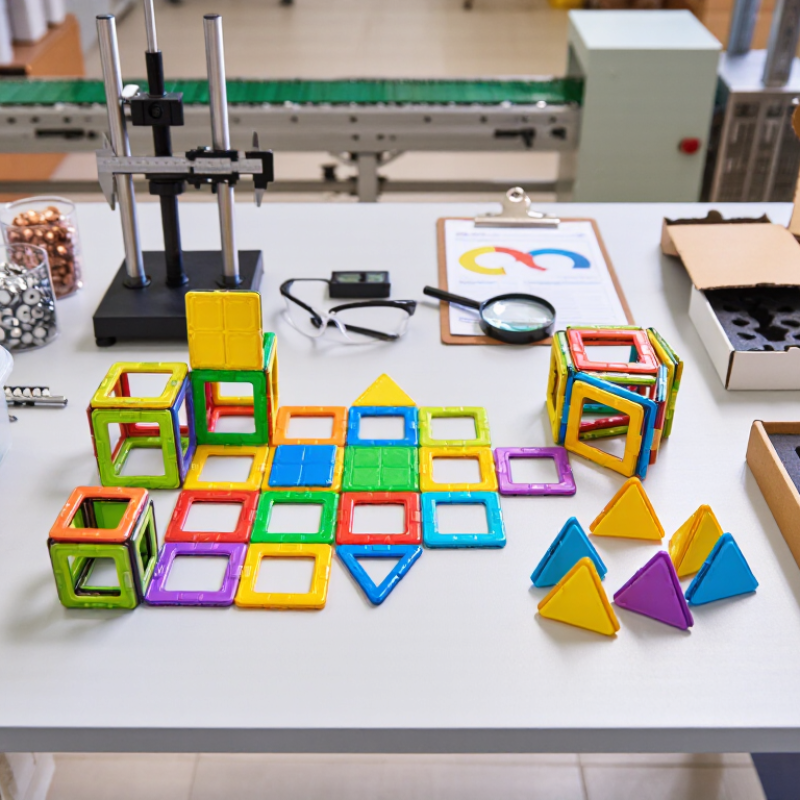
Magnetic block toys are construction pieces with magnets sealed inside their edges or corners. The magnets help pieces connect when their poles attract, allowing children to build towers, walls, and simple geometric shapes. Turn a block around, and the connection may weaken or repel. That’s part of the discovery. Children can test balance and symmetry while watching how small changes affect a structure.

Most sets use plastic shells around the magnets, but construction and magnet strength vary. A sturdy connection can support a broad base, while a tall, narrow tower may wobble or fall. This makes building a hands-on lesson in stability, not just matching pieces. One limitation is easy to overlook: a model can look secure but separate when lifted. Adult guidance also matters, especially for younger children; check the maker’s age guidance and inspect pieces for cracks or loose parts.

Tips: Start with a flat surface and a wide base. Add pieces slowly, then gently test the structure before moving it. Keep blocks away from mouths, and stop using any damaged piece. I’d also encourage children to rebuild after a collapse; the reason it fell is often more useful than the finished tower.

How China’s Magnetic Toy Manufacturing Industry Is Organized

China Top Magnetic Blocks Toys Manufacturers?
How China’s Magnetic Toy Manufacturing Industry Is Organized

China’s magnetic-block supply chain is usually organized around specialist suppliers, not one factory doing everything. One workshop may mold the plastic shells; another supplies magnets; an assembler fits and seals each piece. Tooling, printing, packaging, and export coordination may sit with separate firms. This division helps manufacturers handle different order sizes, but it can make quality tracing harder.

UN Comtrade records China’s 2022 exports of toys and related products under HS 9503 at roughly US$38 billion. That broad category includes many products, not magnetic blocks alone, so it should not be read as a magnetic-toy sales figure. It does show the scale of China’s export-oriented toy network. The China Toy and Juvenile Products Association’s industry reporting also tracks export activity and manufacturing conditions, useful context when assessing suppliers.

On the factory floor, inspectors may check magnet placement, shell seams, dimensions, and surface finish. They can sample pieces after drop or pull testing, then compare results with applicable toy-safety standards, such as ISO 8124-1. Details matter. A block can look smooth while hiding a weak seam. Buyers should ask who makes the magnets, where final assembly happens, and how batches are identified. Supplier directories rarely answer these questions clearly. That gap deserves more attention.

China Top Magnetic Blocks Toys Manufacturers? - How China’s Magnetic Toy Manufacturing Industry Is Organized

Industry Segment Typical Responsibilities Common Production Inputs or Outputs Practical Evaluation Points
Product Design and Engineering Develops block shapes, connection layouts, set configurations, packaging concepts, and product specifications. Some factories handle this in-house; others work from buyer-provided designs. CAD drawings, prototypes, bills of materials, assembly instructions, and product specifications. Check whether prototypes are tested for connection strength, usability, age suitability, and consistency with the approved design.
Plastic Parts Production Moulds the outer plastic components, commonly using injection-moulding processes. Part geometry and mould condition affect fit, finish, and repeatability. Plastic shells, panels, tiles, frames, and other moulded components. Review material documentation, mould maintenance practices, dimensional checks, surface finish, and controls for sharp edges or defects.
Magnet Sourcing and Handling Sources magnets from specialist suppliers and manages their identification, storage, orientation, and delivery to assembly operations. Magnets specified by dimensions, grade, coating, and other technical requirements; incoming inspection records. Verify that magnet specifications are documented and that incoming lots are traceable and checked against the approved requirements.
Magnet Insertion and Enclosure Places magnets into the plastic components and seals or joins the parts so magnets remain inaccessible during intended use. Assembled magnetic pieces and records of assembly checks. Inspect enclosure quality and magnet retention. Test methods should reflect the applicable toy-safety requirements and product design.
Assembly and Set Packing Combines finished components into sets, checks quantities and configurations, and packs products with instructions and required packaging information. Finished toy sets, component lists, user instructions, and retail or shipping packaging. Check set-count accuracy, packaging specifications, lot identification, and consistency between the product and its instructions.
Quality Control and Testing Uses incoming, in-process, and final checks to identify material, assembly, appearance, and packing issues. Independent laboratories may be engaged for testing. Inspection plans, test samples, defect records, corrective actions, and test reports where applicable. Ask for the test scope, sample identification, report dates, and evidence that the tested product matches the production version.
Safety and Market Compliance Coordinates product assessment against the requirements of the intended sales market. Applicable rules depend on product design, age grading, and destination. Technical files, risk assessments, labels, test documentation, and market-specific conformity records. For example, China’s GB 6675 series, the European EN 71 series, and the U.S. ASTM F963 may be relevant in their respective contexts. Confirm current requirements with a qualified compliance provider.
OEM and ODM Services OEM production generally follows a buyer’s product specification; ODM services may include factory-led design or product development. The exact scope varies by supplier. Custom colours, components, packaging, product revisions, or production to an approved specification. Clarify ownership and approval of drawings, tooling, changes, quality criteria, and responsibility for compliance documentation.
Export and Supply-Chain Coordination Coordinates production schedules, export packaging, shipping documents, and hand-offs among the factory, buyer, freight forwarder, and other service providers. Production schedules, packing lists, shipping marks, and export-related documents. Confirm production capacity, lead-time assumptions, shipment inspection arrangements, and which party is responsible for each logistics step.

This table describes common functions in the magnetic construction-toy supply chain. Individual factories may combine several functions or rely on specialist suppliers; capabilities and compliance status should be verified for each product and order.

Leading Magnetic Block Toy Manufacturers in China

Leading Magnetic Block Toy Manufacturers in China

China’s magnetic block toy manufacturers often combine product design, molding, magnet installation, and packaging within one supply chain. For buyers, that can simplify communication and shorten sample revisions. A capable factory should explain its material choices, magnet placement, and production checks in plain language. Details matter.

Ask how magnets are secured inside each piece, and how finished blocks are checked for sharp edges, loose parts, and consistent connections. Request samples from a normal production run, not only carefully prepared display pieces. Color, fit, and magnetic strength can vary slightly between batches. That deserves attention.

Experienced suppliers can adjust block shapes, colors, packaging, and set sizes for different markets. Still, customization may increase tooling costs or extend lead times, so confirm both before approving an order. Review inspection records and discuss age grading and applicable toy-safety requirements with the manufacturer. A polished sample is useful, but it is not proof of stable mass production. Good communication helps; clear written specifications help more.

How Manufacturers Address Quality and Toy Safety

For magnetic block toys, safety starts with the parts children cannot see. A manufacturer should check magnet strength, housing dimensions, and plastic quality before assembly. Magnets need secure enclosure, with no sharp edges or loose parts after impact testing. Small details matter. A tiny crack near a seam can change how a block performs after repeated drops.

Reliable quality control continues on the production line. Staff can inspect samples from each batch, test connections, and check that coatings stay smooth after rubbing. Drop and twist tests help reveal weak joints, while packaging checks confirm that age guidance and warnings remain readable. Records should link test results to specific batches, so problems can be traced rather than guessed at. Records matter.

Testing is not a one-time promise. A careful manufacturer reviews designs when materials, suppliers, or tooling change, then checks whether previous results still apply. Independent laboratory testing can add useful evidence, though buyers should confirm its scope and date. No checklist catches everything. Even a strong process can miss an unusual failure, so clear feedback channels and prompt investigation are important signs of responsible production.

How to Compare and Select a Chinese Magnetic Blocks Supplier

How to Compare and Select a Chinese Magnetic Blocks Supplier

Circana reported that toy sales across 12 major markets grew 7% in the first half of 2024. That growth makes supplier selection more important, not less. A polished catalogue cannot prove consistent production. Ask for dated production records, material specifications, and independent test reports for the exact block set you plan to order. Check that colors, magnet placement, and connection strength match approved samples across repeated batches.

Look beyond the quoted unit price. Compare minimum order quantities, sample fees, tooling costs, lead times, and the supplier’s process for handling defects. Request a sample and inspect it yourself: connect pieces, pull them apart, and check for sharp edges, loose components, or uneven seams. Ask which toy safety standards the product is tested against in your target market, and verify reports with the issuing laboratory where possible. Details matter.

Grand View Research has identified rising demand for construction toys as a market growth factor, but market forecasts do not guarantee a supplier’s reliability. No checklist is perfect. I would also ask how the factory controls magnet installation and records batch changes. A supplier’s willingness to share clear evidence can be more useful than a confident sales pitch. Their answers may be imperfect; the gaps are worth discussing before production.

FAQS

What are magnetic block toys?

They are construction pieces with magnets sealed inside their edges or corners. The magnets connect when their poles attract.

Why might blocks stop connecting when turned around?

Turning a block can change how its magnetic poles meet. The connection may weaken or repel. Small changes matter.

How can children build a steadier tower?

Start on a flat surface with a wide base. Add blocks slowly, then gently test the structure before moving it.

Why might a tall tower wobble or fall?

A narrow base may not support its height, even when the blocks connect firmly. A neat tower can still be misleading.

What should adults check before play?

Follow the maker’s age guidance and inspect pieces for cracks or loose parts. Keep blocks away from mouths, and stop using damaged pieces.

What can children learn when a structure collapses?

They can explore balance and symmetry by changing the shape or base. Rebuilding may reveal why the tower fell. That lesson is easy to miss.

How is magnetic block production organized in China?

Different suppliers may mold shells, provide magnets, assemble pieces, or handle packaging. This division supports different order sizes but can make quality tracing harder.

What quality checks may factories perform?

Inspectors may check magnet placement, shell seams, dimensions, and surface finish. They may also sample pieces for drop or pull tests.

What does China’s reported toy-export figure show?

A 2022 figure of roughly US$38 billion covers a broad toy category. It does not represent magnetic blocks alone.

Conclusion

Magnetic Blocks Toys are construction sets made with magnetized pieces that connect in multiple directions, allowing children to create shapes, structures, and imaginative designs. Their appeal comes from simple assembly and flexible play, while product design should also consider age suitability, material durability, and secure magnetic components. China’s magnetic toy industry includes manufacturers with different strengths, from product development and mold making to assembly, customization, and export support.

When comparing suppliers, buyers can look beyond price to assess production capacity, communication, customization options, quality-control procedures, and experience with toy safety testing. Reliable manufacturers use suitable materials, inspect products during production, and provide clear documentation for evaluation. A thoughtful supplier selection process helps balance design, cost, consistency, and safety, making it easier to choose a partner whose capabilities match the intended product and market.

Sienna

Sienna

Sienna is a skilled marketing professional with a deep expertise in our company’s core products and services. With a passion for innovation and detail, she plays a pivotal role in crafting insightful blog posts that not only highlight the unique features of our offerings but also provide valuable......