Choosing Foam Magnetic Blocks for wholesale is not simply a price comparison. It is a product-quality decision.
Grand View Research valued the global toys market at approximately USD 108.7 billion in 2023. Its report also forecasts continued growth through 2030. This wider market signal matters. However, Foam Magnetic Blocks remain a specialized category, so broad toy data cannot predict every purchasing result. That limitation deserves attention.
Retail buyers should examine foam density, magnet strength, edge finishing, block dimensions, packaging efficiency, and age guidance. A soft block may feel safe, yet weak stitching or exposed magnets can create serious quality concerns. Ask suppliers for material specifications, batch samples, and independent safety-test documentation. ASTM F963 and relevant regional toy-safety requirements should guide verification, not replace it.
Dr. Kathy Hirsh-Pasek, a leading play and child-development researcher, states, “Play is not a luxury. Play is a necessity.” Her view supports products that encourage open-ended construction, rather than one-use novelty. Foam Magnetic Blocks can offer that value when shapes connect easily, colors remain consistent, and children can rebuild without frustration.
Wholesale decisions also require practical testing. Place sample cartons on a pallet. Check crushed corners, odor, surface recovery, and magnet alignment after repeated use. Then compare landed cost, minimum order quantity, defect policy, and replenishment speed.
The cheapest supplier may become expensive later.
A useful purchasing framework should include evidence, not optimism. Some supplier claims will remain unclear. That is acceptable, but unverified claims should never become purchasing assumptions.
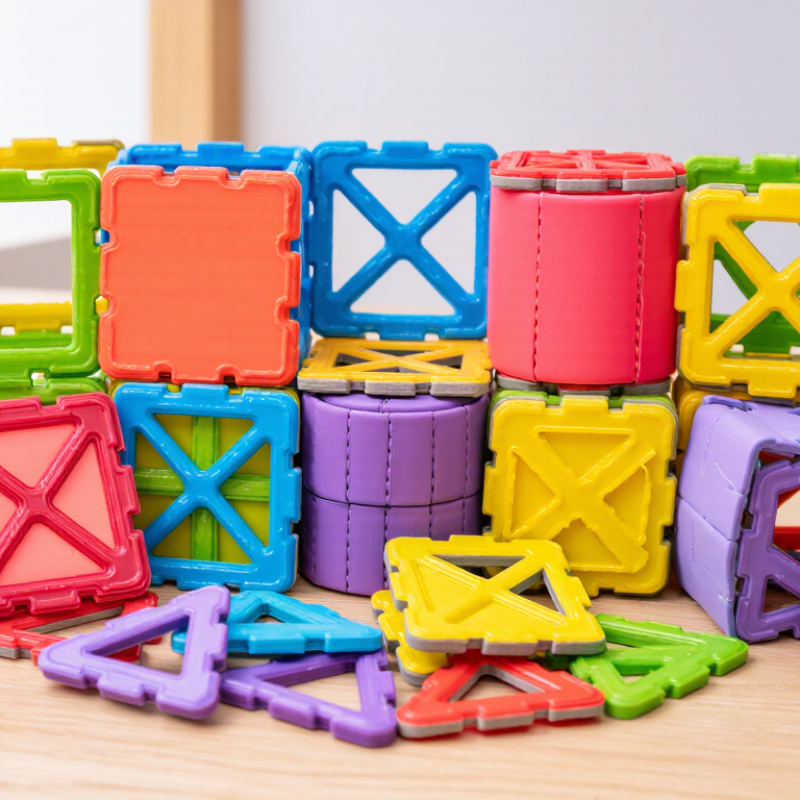
How to Choose Foam Magnetic Blocks for Wholesale?
Define Foam Block Specs: EVA Density, Size, Shape, and Magnet Grade
Start with EVA density, because softness controls play feel and service life. A practical wholesale range is 45–75 kg/m³ for lightweight construction blocks. Lower density feels softer but may dent quickly. Higher density improves shape retention, yet can feel less comfortable for children. Ask suppliers for density results tested under ASTM D3575 methods. Do not trust “high-density” as a complete specification. Size matters too. Blocks around 50–75 mm are easy for small hands to grip, while larger pieces support safer, more stable towers. However, bigger blocks increase carton volume and shipping cost.
Shape affects both creativity and packaging efficiency. Use cubes, arches, triangles, and columns with consistent tolerances. A 1–2 mm variation can make magnetic connections feel uneven. For magnets, N35 or N42 grades are common starting points, but grade alone does not define holding strength. Magnet diameter, thickness, coating, and contact area matter more than many buyers expect. Require pull-force testing on the finished foam block, not only on loose magnets.
Tips: Request samples from three production batches. Check compression recovery after repeated use. Inspect seams, surface tears, and magnet placement. The U.S. Consumer Product Safety Commission reported about 2,400 emergency-room visits involving high-powered magnet ingestion from 2017 to 2021. Therefore, verify secure encapsulation, age labeling, and applicable toy-safety testing before ordering. A tidy specification can still miss real-world abuse. Test blocks after drops, twisting, and cleaning.
| Specification Dimension | Recommended Wholesale Range | Typical Options | Why It Matters | Inspection or Purchasing Checkpoint |
|---|---|---|---|---|
| EVA Foam Density | 35–80 kg/m³ for general magnetic building blocks | 35–50 kg/m³: lightweight; 50–65 kg/m³: balanced; 65–80 kg/m³: firmer and more durable | Density affects firmness, compression resistance, weight, surface feel, and shipping cost. Higher density does not automatically mean higher quality. | Request a density test report and verify the result from finished blocks rather than relying only on the raw-material specification. |
| EVA Hardness | Approximately 20–45 Shore C, depending on the intended age group | 20–30 Shore C: soft-touch; 30–40 Shore C: general use; 40–45 Shore C: rigid construction | Hardness influences grip, shape retention, impact comfort, and the ability of blocks to stand in larger structures. | Specify the test method, sampling location, and acceptable tolerance because hardness readings can vary with temperature and surface texture. |
| Block Size | 30–100 mm for each main dimension | 40 × 40 × 40 mm cubes; 80 × 40 × 20 mm rectangular prisms; 100 × 50 × 20 mm large-format pieces | Size affects handling, construction stability, packaging efficiency, and age suitability. Larger pieces are easier for young children to hold. | Define dimensional tolerance, commonly ±1–2 mm for molded or die-cut foam parts, and check fit between mating pieces. |
| Shape Selection | Use 3–6 complementary shapes per set | Square, rectangle, triangle, semicircle, arch, and connector or wheel shapes | A balanced shape mix supports flat mosaics, three-dimensional structures, arches, vehicles, and symmetrical designs. | Check corner radii, edge finishing, shape consistency, and whether each shape offers enough contact area for stable magnetic connections. |
| Magnet Type | Neodymium magnets for compact, high-strength connections | Disc, cylinder, or ring magnets fully enclosed inside the EVA component | Neodymium magnets provide greater magnetic strength in a smaller package than common ferrite magnets, helping keep blocks compact. | Confirm magnet dimensions, polarity orientation, encapsulation method, and resistance to movement after repeated use. |
| Magnet Grade | N35–N42 is generally suitable for foam building blocks; higher grades require careful force and safety evaluation | N35: economical; N38–N42: stronger connection; N45 and above: specialized applications | The grade indicates the magnet's maximum energy product, but actual holding force also depends on size, air gap, coating, orientation, and the mating surface. | Do not select by grade alone. Request measured pull force and test the complete finished block assembly. |
| Magnet Pull Force | Set a finished-product target appropriate to the block size and intended age group | Specify a measured range in newtons rather than using magnet grade as the only requirement | Excessive force can increase pinch risk, while insufficient force can cause structures to collapse during normal play. | Use a consistent pull-force method, record the air gap and contact surface, and test after aging, impact, and repeated assembly cycles. |
| Magnet Coating | Nickel-copper-nickel or another specified protective coating suitable for the application | Multi-layer plated coating; additional encapsulation inside foam | Coating helps protect the magnet from corrosion and surface damage, but it is not a substitute for secure encapsulation. | Inspect for cracks, peeling, rust, sharp edges, and movement after abrasion, humidity, and drop testing. |
| Magnet Encapsulation | Fully enclosed with no direct access to the magnet during normal use | Heat-laminated EVA layers, molded EVA enclosure, or mechanically secured sealed pocket | A secure enclosure reduces the risk of magnet release, swallowing hazards, cuts, and product failure. | Perform seam inspection, tensile or pull-out testing, drop testing, and repeated-use testing on production samples. |
| Surface and Edge Finish | Smooth, clean, low-odor surface with rounded or softened edges | Closed-cell EVA with smooth lamination or clean die-cut edges | Good finishing improves comfort, appearance, cleanability, and resistance to tearing or surface flaking. | Check for flash, burrs, exposed adhesive, color transfer, strong odor, delamination, and uneven edges. |
| Color and Layer Construction | 2–8 contrasting colors; single-layer or laminated multi-color construction | Solid colors, two-tone pieces, printed surfaces, or color-coded shape families | Color variety increases play value and helps users identify shape groups, orientation, and construction patterns. | Approve a color standard, verify batch consistency, and test colorfastness and surface adhesion. |
| Wholesale Packaging | Retail sets of 12–60 pieces; master cartons packed by weight and volume | Reusable zipper bag, paperboard box, molded tray, or recyclable carton | Packaging affects landed cost, shelf presentation, damage protection, and warehouse efficiency. | Confirm piece count, carton dimensions, gross weight, drop protection, barcode area, and packaging material requirements. |
Check applicable toy-safety standards for the destination market. These may include ASTM F963, EN71, ISO 8124, and 16 CFR 1501. Requirements can differ by country and age grading. Always verify the current edition.
The report should identify the exact product, materials, model, and test date. It should also name the testing laboratory. A generic certificate is not enough. Match the report with the ordered design.
Paperwork cannot reveal every production problem. Inspect edges, seams, foam density, and magnetic compartments. Pull, twist, and impact the blocks repeatedly. Magnets must stay enclosed. Do not inspect foam alone.
Check every small piece carefully. Loose parts may create choking risks for young children. Review connectors, packaging, instructions, warnings, and age labels. They should communicate the same safety information. Small details matter.
Ask whether the MOQ applies per color, design, or total order. Typical quantities may range from 500 to 10,000 sets. A lower MOQ may protect cash flow. However, packaging and production costs may increase. The cheapest option is not always practical.
Compare block dimensions, foam density, magnet strength, and included pieces. A lower price may reflect thinner foam or fewer connectors. Request carton quantity, net weight, gross weight, and replacement terms. Compare equivalent products only.
Separate sampling, production, inspection, and shipping time. A promised seven-day schedule may exclude approvals. Add a buffer of one or two weeks. Delays happen. Plans need breathing room.
Include product price, packaging, freight, insurance, import charges, and payment fees. Add inspection and local delivery costs. Divide the total by usable units, not ordered units. Oversized cartons can quietly increase freight costs. Recheck actual measurements.
Order samples before committing to a large shipment. Test the magnets and seams carefully. Inspect ten random sets from a pilot batch. Keep quotations, revisions, and inspection records together. Some estimates will still be wrong.
Choosing Foam Magnetic Blocks for wholesale requires more than comparing appearance and price. Start by defining the product specifications, including EVA foam density, block dimensions, shapes, colors, and magnet grade, so the blocks match your target market and intended age range. Safety should be verified through relevant requirements such as ASTM F963, EN71, ISO 8124, and CPSC 16 CFR 1501. Pay particular attention to magnet security by reviewing pull force, encapsulation quality, durability after impact and compression testing, and potential ingestion risks.
A complete wholesale evaluation should include MOQ, unit pricing, production lead time, shipping expenses, and total landed cost rather than relying on the factory quote alone. Before placing an order, audit the supplier’s quality system and request current testing reports, clear inspection procedures, and warranty terms. An AQL 1.5 sampling plan can help assess consistency in dimensions, foam quality, magnet placement, and packaging. Combining technical specifications, safety verification, cost analysis, and supplier reliability will support a safer and more predictable purchase decision.