Finding China’s best Building Magnetic Blocks for wholesale requires more than comparing catalog prices. A reliable sourcing process examines materials, magnet strength, factory experience, and quality control together. For importers, these details affect safety, customer satisfaction, and long-term business performance.
Good Building Magnetic Blocks should use durable, child-friendly plastic with smooth edges and securely enclosed magnets. Each tile should connect firmly without feeling difficult for small hands. Bright colors, consistent shapes, and clear packaging also influence retail appeal. A professional supplier should provide product specifications, sample sets, test reports, and transparent production information. However, documents alone are not enough.
See the product in your hands.
Request samples before placing a large order. Check whether corners crack after repeated use. Test the magnetic connection with different shapes. Inspect the box, instruction sheet, and individual pieces. These simple steps reveal problems that polished photos may hide. Factory audits, production videos, and third-party inspections can add further confidence, especially for overseas buyers.
Wholesale decisions also depend on minimum order quantities, lead times, customization options, and shipping support. Some factories offer attractive prices but provide limited communication after payment. Others charge more while delivering steadier quality and faster problem solving. The cheapest option is not always the most economical choice.
This guide compares important supplier qualities, product features, and purchasing considerations. It aims to help distributors, educators, and retailers make informed decisions. Still, every buyer should verify current standards and supplier claims independently. No sourcing guide can replace careful sampling and practical judgment.
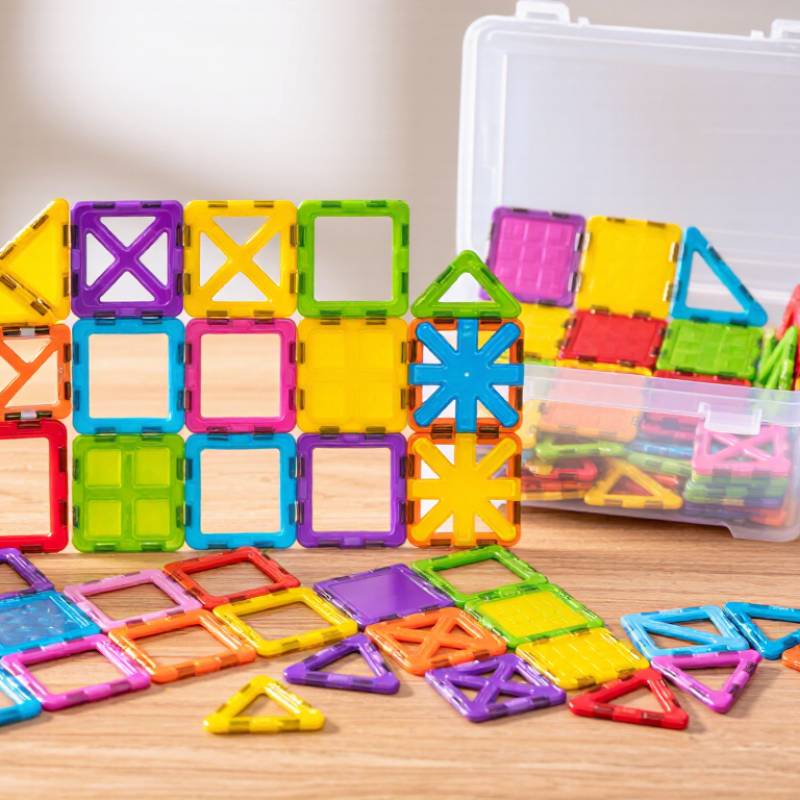
Building magnetic blocks are construction toys with embedded permanent magnets. Each block usually contains magnets sealed inside plastic, allowing edges to attract or repel. Children connect squares, triangles, and other shapes by matching magnetic poles. A flat pattern can become a tower, bridge, or small vehicle within minutes. The mechanism is simple. The engineering is not.
Magnetic force depends on magnet grade, size, distance, and shielding. Stronger magnets improve stability, but they also increase safety demands. The U.S. Consumer Product Safety Commission has repeatedly warned about swallowed high-powered magnets, especially when products break apart. For wholesale sourcing, buyers should request independent testing against ASTM F963, EN 71, and ISO 8124. They should also inspect drop tests, seam strength, magnet retention, and batch records. A certificate alone can be outdated.
Market data supports continued interest in construction play. Grand View Research reported that the global construction toys market reached billions of dollars in recent years, with STEM learning supporting demand. Circana also reported changing toy sales patterns after 2023, making durable, reusable products more attractive to retailers. Still, reports cannot replace hands-on inspection. I would test a sample on a tiled floor, twist each connection, and check every exposed edge. Some sets look precise in photographs but feel loose in practice. That gap needs honest review.
China offers a practical sourcing base for wholesale magnetic building blocks. Its manufacturing clusters connect mold makers, plastic processors, magnet suppliers, and packaging factories within short shipping distances. This can reduce coordination time and support more flexible order quantities.
Experienced buyers usually compare more than unit prices. They inspect magnet strength, connector alignment, plastic edges, color consistency, and packaging durability. A reliable supplier should provide material details, test records, age recommendations, and samples before production. Independent quality checks can verify whether magnets remain secure after repeated drops and twisting.
Customization is another reason to source from China. Factories can adjust colors, shapes, storage boxes, instruction sheets, and educational configurations. A sample may look excellent, but mass production can still reveal small differences. That is where careful inspections matter. No factory is perfect. Buyers should confirm production tolerances, replacement policies, carton dimensions, and shipping terms in writing.
China also supports different wholesale models, from trial orders to container-level purchasing. Clear communication helps avoid costly misunderstandings about product dimensions and included parts. Some suppliers respond quickly but provide weak documentation. Others offer strong records but less flexibility. The right choice depends on testing standards, target market, budget, and delivery schedule. A lower quote can become expensive when defects, delays, or missing compliance documents appear later.
When evaluating magnetic blocks for wholesale, inspect more than colorful packaging. Check whether each magnet stays fully enclosed after repeated drops, twists, and pulls. Loose or swallowed magnets can cause serious injury, so secure construction is essential. Examine corners and edges for sharp flashes, cracks, or brittle plastic. A strong block is not automatically a safe block.
Ask the supplier for recent test reports from qualified laboratories. Depending on the market, relevant requirements may include EN 71, ASTM F963, or CPSIA testing. Verify that the documents match the exact product, materials, and age grading. Batch numbers, factory records, and traceable inspection results make quality claims more reliable. Do not accept a generic certificate without checking its scope.
Design quality also affects play value and returns. Pieces should connect smoothly, hold firmly, and separate without excessive force. Check polarity consistency across samples. Uneven attraction can frustrate children and complicate construction. Request samples from different production batches, not only a polished showroom set. A small color mismatch may seem harmless, but it can reveal weak process control. No checklist is perfect. Wholesale buyers should record failures, question unclear answers, and balance creative design with realistic safety limits.
Reliable Chinese manufacturers of building magnetic blocks should offer more than attractive prices. They need consistent magnets, accurate molding, and stable production capacity. Ask for factory registration, production photos, inspection records, and recent test reports. A serious supplier should explain magnet strength, plastic composition, age grading, and packaging options clearly.
Request physical samples before discussing large wholesale orders. Check whether each block connects smoothly and separates without excessive force. Inspect corners, surface finish, magnet placement, and printed instructions. Small details matter. Loose parts can damage customer trust. Ask for testing documentation that matches the destination market, such as reports covering mechanical safety, material limits, and magnet security.
A dependable manufacturer usually provides a written quotation with minimum order quantity, sample fees, lead time, carton size, and payment terms. Confirm how defects are handled before production begins. Photos during assembly can help, but independent pre-shipment inspection offers stronger evidence. Communication should be direct and traceable. Delayed replies may become delayed deliveries.
I have learned that low prices often hide costs in packaging, rework, or inconsistent color batches. No supplier gets every batch perfect. That is why a small trial order is useful before scaling. Manufacturers willing to improve mold details, adjust packaging, and share corrective-action records often deserve closer attention. Still, buyer checks remain necessary. Trust should be built through repeated inspections, not promises alone.
| Manufacturer Capability Type | Typical Product and Wholesale Profile | Reliable Wholesale Benchmarks | Buyer Verification Points | Main Wholesale Risk | Priority |
|---|---|---|---|---|---|
| Standard Magnetic Tile Manufacturer | Produces flat magnetic tiles for home, classroom, and retail distribution. Common components include plastic panels, enclosed magnets, and geometric connectors. | Consistent dimensions across production batches; smooth edges; magnets fully enclosed; stable color matching; carton packaging suitable for export. | Request pre-production samples, dimensional inspection records, magnet-retention testing, packaging specifications, and batch photographs before shipment. | Weak magnet retention, inconsistent panel dimensions, or sharp plastic edges can increase returns and safety complaints. | High |
| Preschool Large-Size Block Manufacturer | Focuses on larger components designed for younger children. Product design normally emphasizes easy handling, rounded edges, and reduced small-part exposure. | Age grading is clearly stated; components are large enough for the intended age group; surfaces are rounded; packaging includes safety and supervision information. | Check the age recommendation, component dimensions, small-parts assessment, material declarations, and applicable toy-safety test reports. | Incorrect age labeling or detachable small components may create compliance and marketplace-listing problems. | High |
| STEM and Educational Set Manufacturer | Supplies magnetic construction sets with activity cards, building challenges, color coding, or classroom-oriented packaging. | Instruction content is accurate and durable; activity cards are available in the required language; set contents are counted and packed consistently. | Approve artwork before mass production, verify the exact piece count, review translation quality, and perform a finished-goods inspection. | Missing pieces, unclear instructions, or poor translations can reduce educational value and increase customer-service costs. | High |
| Custom OEM and Private-Label Manufacturer | Supports customized colors, molds, packaging, instruction manuals, inserts, and product configurations for distributors or retailers. | Uses documented approval samples, maintains artwork version control, confirms mold ownership terms, and separates approved specifications from later changes. | Obtain a written specification sheet, approved golden sample, packaging dieline, intellectual-property terms, and change-control procedure. | Unapproved material, color, packaging, or component changes may occur when specifications are not formally controlled. | Medium |
| Export-Compliance-Oriented Manufacturer | Organizes production and documentation for different destination markets, including toy-safety testing, labeling, traceability, and shipment records. | Can identify the applicable destination-market requirements and provide current reports linked to the exact product, materials, and factory address. | Confirm report scope, model numbers, test dates, laboratory details, product photographs, warning labels, and batch traceability. | A test report for a similar product may not cover the actual magnetic set being imported. | High |
| Flexible Packaging and Assembly Manufacturer | Offers multiple packaging formats, including color boxes, display cartons, polybags, molded trays, and mixed-SKU export cartons. | Packaging protects the product during stacking and transport; carton marks, inner-pack quantities, and barcode placement are controlled. | Conduct a packaging drop or compression assessment, confirm carton dimensions, check gross weight, and approve a sealed shipping sample. | Oversized cartons, weak inserts, or inaccurate carton weights can raise freight costs and cause transit damage. | Normal |
| High-Volume Automated Production Manufacturer | Uses automated or semi-automated molding, assembly, counting, and packing processes for repeat wholesale orders. | Demonstrates stable capacity, documented quality checkpoints, calibrated inspection equipment, and a defined production lead-time process. | Review the production flow, inspect in-process controls, compare sample quality across batches, and confirm realistic capacity commitments. | Rapid production scale-up without adequate inspection may increase defects, color variation, or packing errors. | Medium |
| Small-Batch and Test-Order Manufacturer | Suitable for market testing, seasonal launches, online sellers, and buyers that need product validation before larger purchase orders. | Provides clear sample pricing, transparent production limits, repeatable specifications, and a practical process for converting a test order into a larger order. | Compare the sample with the mass-production version, confirm reorder terms, and document acceptable tolerances for color, dimensions, and packaging. | Small-batch pricing may not remain competitive at scale, and the supplier may subcontract larger production runs. | Normal |
| Quality-Control-Structured Manufacturer | Maintains incoming-material checks, first-article approval, in-process inspection, final inspection, and corrective-action records. | Uses written acceptance criteria for appearance, dimensions, magnet placement, component count, packaging, and labeling. | Request a quality manual or inspection checklist, review a recent inspection record, and agree on an acceptance standard before production. | Verbal quality promises without written acceptance criteria are difficult to enforce during a shipment dispute. | High |
| International Logistics-Ready Manufacturer | Supports export carton marking, commercial invoices, packing lists, shipping coordination, and destination-specific documentation. | Provides accurate carton counts, product descriptions, net and gross weights, dimensions, and shipment-ready packing information. | Compare shipping documents against the actual packed goods and confirm responsibility for export paperwork, labeling, and freight coordination. | Inaccurate shipping data can delay customs clearance or create unexpected freight and handling charges. | Medium |
China Best Building Magnetic Blocks for Wholesale?
When comparing Chinese building magnetic blocks, do not judge price from the first quotation. Request the unit price at several quantities, such as 500, 2,000, and 5,000 sets. Check whether the quote includes molds, inserts, manuals, and quality inspection. A low factory price may hide higher tooling fees or weaker materials. Ask for samples and test the connector strength, edge finish, color consistency, and box durability. Safety documentation should match your target market’s requirements, especially for magnets and small parts.
Customization needs clear boundaries. Confirm the number of pieces, shapes, colors, logo method, instruction language, and sample approval process. Digital artwork is not enough. Approve a physical sample before mass production. Packaging also affects the real cost. Compare individual boxes, inner cartons, pallet use, carton dimensions, and drop-test results. Smaller packaging can reduce freight, but crowded pieces may arrive scratched.
Shipping terms require careful reading. Compare EXW, FOB, and delivered quotations with the same order quantity and destination. Request carton size, gross weight, production time, port, and estimated transit time. Calculate landed cost, not just the product price. Build a small buffer for inspections or port delays. No spreadsheet catches every delay. I would also question unusually fast promises. A cheaper offer can become expensive after revisions, repacking, or customs paperwork. Reliable suppliers answer these details consistently and provide traceable production records.
Manufacturing clusters often place mold, plastic, magnet, and packaging suppliers close together. This can shorten coordination time and support flexible order quantities. Samples matter.
Check magnet strength, connector alignment, plastic edges, colors, and packaging durability. Twist and drop samples repeatedly, then inspect loose parts or damaged corners. Small defects spread.
Request material details, age recommendations, test records, and packaging specifications. Ask for factory information, recent inspection reports, and destination-market safety documents. Records reduce uncertainty.
Request prices for several quantities, such as 500, 2,000, and 5,000 sets. Confirm whether tooling, inserts, manuals, inspection, and packaging are included. A cheap quote may hide later costs.
Confirm piece counts, shapes, colors, instruction languages, storage boxes, and sample approval steps. Approve a physical sample before mass production begins. Digital artwork is not enough.
Compare individual boxes, inner cartons, pallet use, carton dimensions, and drop-test results. Compact packaging may lower freight costs but can cause scratches when pieces are crowded. Packaging affects customer experience.
Compare EXW, FOB, and delivered quotations using the same quantity and destination. Request gross weight, carton size, production time, shipping point, and estimated transit time. Calculate landed cost.
A small order can reveal color changes, weak magnets, missing parts, or delayed production. Independent pre-shipment inspection provides stronger evidence than photos alone. Trust takes time.
Treat quick replies and low prices as useful signals, not proof of reliability. Confirm defect handling, replacement policies, production tolerances, and delivery terms in writing. The process is not perfect.
Building Magnetic Blocks are versatile construction toys made with embedded magnets that allow pieces to connect, separate, and form three-dimensional structures. Their simple joining mechanism supports creative play, spatial reasoning, and STEM learning. For wholesale buyers, China is an attractive sourcing destination because it offers broad manufacturing capacity, competitive pricing, flexible production volumes, and customization options. However, selecting a suitable supplier requires more than comparing unit costs.
Buyers should evaluate magnetic strength, material durability, smooth edges, connector security, color quality, and age-appropriate safety features. Reliable manufacturers should also provide consistent quality control, clear product specifications, testing documentation, and stable production schedules. When comparing wholesale solutions, consider tooling and customization fees, minimum order quantities, packaging design, carton protection, lead times, payment terms, and shipping arrangements. A careful comparison of total landed cost, communication efficiency, and after-sales support can help importers choose safe, attractive, and commercially practical magnetic building sets for different markets.